
Gender Equality

CAU’s gender equality framework is guided by the Human Resources Department, the Women’s Council, and the Student Well-being Office, which jointly ensure that every policy, activity, and opportunity reflects fairness, transparency, and respect. The university’s approach goes beyond equal representation - it emphasizes equal opportunity, equal pay, leadership participation, and personal well-being for all.
Tracking women’s access to CAU
Central Asian University follows every admissions cycle at each stage, from application to the first day of class, and by faculty. Looking at these numbers every year helps us see where women join the university and take action wherever a gap appears.
Admissions pipeline, intake
Each stage of the admissions cycle, from the full applicant pool to the students who began their studies.
Enrolled students by faculty
Women and men among students who started this year. The dashed line marks equal representation (50%).
This work supports Sustainable Development Goal 5, equal opportunity for women and girls in education.
Advancing gender equality at Central Asian University
At Central Asian University, gender equality is part of how we welcome and support every student. Our work contributes directly to SDG 5, which calls for equal opportunities for women and girls in education and beyond.
Tracking women’s access to CAU
CAU follows every admissions cycle at each stage, from application to the first day of class, and by faculty. Looking at these numbers every year shows where women join the university and where action is needed when a gap appears.
Fair, transparent admissions, an inclusive campus and strong academic support help young women in Uzbekistan and across Central Asia pursue their ambitions, build their careers and take on leadership roles in their communities.
Admissions funnel, 2026 intake
Gender of 700 enrolled students
Scholarships and financial support for women’s education
Through a range of scholarships and financial assistance options, CAU gives eligible female applicants and students opportunities to reduce tuition costs, gain recognition for their achievements and pursue their educational goals. CAU’s scholarship programs are open to eligible students regardless of gender.
These opportunities support women’s access to higher education, recognize their academic achievements and encourage their participation across diverse disciplines.
Zulfiya State Prize
Recognizes talented young women in education, science, information technology, medicine, culture and public service. Through national recognition and financial benefits, the award encourages young women to pursue academic excellence and develop their talents.
Parent-Child Room on campus
CAU provides a dedicated Parent-Child Room to help students and staff with young children balance family responsibilities with their academic and professional commitments. Parents can study, work, attend informal meetings or take breaks while caring for their children.
Access to appropriate facilities helps student mothers keep attending classes and taking part in university life while managing childcare. The room is open to students, professors and staff with children.
What the room offers
Maternity and paternity leave
CAU strictly adheres to the Labour Code of the Republic of Uzbekistan, protecting the parental rights of both female and male employees. Female employees are entitled to paid maternity leave before and after childbirth, and fathers may take paternity leave to care for their newborns. Employees keep their workplace and position during leave, and their employment rights are fully protected.
CAU upholds equal pay for equal work: male and female staff receive the same compensation regardless of gender or position.
Promoting awareness of the mother–child relationship
CAU organized a lecture on the mother–child relationship, delivered by a professor from CAU’s Medical School. The session focused on the emotional bond between mothers and children, early child development and the role of mothers in supporting children’s physical and emotional well-being.
The initiative raised awareness of motherhood and child development, and of the importance of supporting women in their maternal roles and a supportive family environment.
Educating women strengthens families, economies and societies
CAU believes that educating women strengthens families, economies and societies, and is proud to be part of that progress.
CAU demonstrates a strong commitment to ensuring balanced participation in higher education. The following data reflects the current distribution among male and female students:
The Student Gender Distribution Diagram visually highlights this parity across studying, enrolled, and graduating categories. The consistent participation of women in academic programs shows CAU’s efforts to maintain gender inclusiveness at all stages of education.
In addition, CAU organizes TEDxWomen events, providing a platform for female students, faculty, and staff to share their experiences, achievements, and ideas on leadership, innovation, and empowerment. These events inspire confidence and create meaningful dialogue on women’s contributions to academia and society.
Gender equality extends beyond classrooms into employment and professional development. CAU maintains a strict Equal Employment Opportunity Policy, ensuring that both men and women have equal chances for recruitment, promotion, and leadership roles.
CAU ensures that no gender-based pay gap exists — salaries are standardized across roles and ranks.
This data confirms that male and female employees receive equal pay for equal work, reflecting CAU’s strong ethical and legal commitment to fairness. Women also serve in senior administrative and academic roles, including deans, department heads, project managers, and researchers, highlighting the university’s success in promoting female leadership. maternity leave
Gender Distribution Among University Staff (2023–2024 Comparison)
The analysis of staff data for 2023 and 2024 demonstrates a positive shift toward gender balance and inclusivity in the university workforce.
In 2023, there were 72 male and 51 female full-time staff members. By 2024, this number significantly increased to 277 males and 184 females, showing a substantial overall growth in employment and a steady improvement in female representation. The proportion of female full-time staff increased from 41% in 2023 to 40% in 2024, indicating that even with overall expansion, the university continues to maintain gender inclusivity across staff categories.
Well-paid Staff:
In 2023, 44 men and 20 women held well-paid positions. In 2024, these numbers grew to 103 men and 64 women, marking a remarkable increase in the number of women in higher-paid roles from 31% in 2023 to 38% in 2024. This positive change suggests that more women are gaining access to senior and well-compensated positions, reflecting the university’s commitment to gender equity in career progression and pay structure.
Between 2023 and 2024, the university not only expanded its workforce but also made significant progress in reducing the gender gap, especially in well-paid positions. The data highlights a clear upward trend in female participation and empowerment, supporting the institution’s broader Gender Equality and Diversity goals.
eased from 41% in 2023 to 40% in 2024, indicating that even with overall expansion, the university continues to maintain gender inclusivity across staff categories.
The Human Resources Department enforces CAU’s Non-Discrimination and Equal Pay Policies, ensuring fairness at every level of employment. These policies prohibit any form of bias based on gender, age, ethnicity, disability, or religion.
HR also provides transparent mechanisms for reporting any instances of harassment or discrimination. Employees and students are encouraged to speak confidentially with HR representatives to ensure a safe, respectful, and inclusive environment.
- Equal pay for equal work
- Equal opportunity for leadership and promotion
- Transparent and fair hiring practices
- Zero tolerance toward harassment and discrimination
- Support for parental leave and flexible work arrangements
Maternity and Paternity Leave Policy at Central Asian University
Central Asian University strictly adheres to the Labour Code of the Republic of Uzbekistan, ensuring full protection of parental rights for both female and male employees. In accordance with Articles 404–412 of the Labour Code and Article 58 of the Constitution, the University guarantees equal access to maternity and paternity leave. Female employees are entitled to paid maternity leave before and after childbirth, while fathers are also permitted to take paternity leave to care for their newborns. During this period, employees retain their workplace and position, and their employment rights are fully protected. CAU upholds the principle of equal pay for equal work, ensuring that both male and female staff members receive the same compensation regardless of gender or position. These policies reflect the university’s commitment to maintaining a supportive, family-friendly, and gender-equal working environment.
CAU provides comprehensive psychological services for both students and staff. A qualified psychologist is available on campus, offering counseling sessions, mental health awareness programs, and workshops on stress management and emotional balance.
The psychologist works closely with the Women’s Council and the Student Well-being Department to ensure that women have access to emotional support, self-development programs, and career guidance. This system reinforces the university’s holistic approach to gender equality - one that includes both professional and personal well-being.
CAU’s Commitment to Women’s Empowerment and Economic Inclusion
In alignment with its dedication to Sustainable Development Goal 5 (Gender Equality), Central Asian Universityproudly launched the “Ayol by CAU” initiative — a pioneering microfinance and women’s empowerment program designed to promote economic independence and leadership among women in Uzbekistan. The initiative reflects CAU’s broader mission to create inclusive opportunities for women through education, entrepreneurship, and social support.
“Ayol by CAU” was established following a nine-month research and development phase inspired by the Grameen Bank model observed in Bangladesh and Turkey. The program is based on Islamic microfinance principles, ensuring ethical and accessible financial solutions for women entrepreneurs. It provides a comprehensive support system combining financial assistance with capacity-building, mentorship, and psychological empowerment.
Through free 10-day offline training programs, participants gain essential knowledge in business fundamentals, marketing, sales via digital platforms (such as Uzum marketplace), and communication strategies for successful entrepreneurship. Graduates of the program receive ongoing mentorship, access to a supportive community network, and tailored financial guidance to launch or expand their own businesses.
Achievements to date include:
- 170 women trained across the first two cohorts;
- 45 graduates (20 from the first and 25 from the second group) successfully approved for microfinance funding;
- Establishment of an active network of women entrepreneurs who mentor and support one another;
- Introduction of psychological support alongside business and financial training, pioneering a holistic approach to women’s empowerment in higher education.
By integrating financial literacy, entrepreneurship training, and mental well-being,
CAU continues to strengthen women’s participation in economic and social development, both within the university community and beyond. The “Ayol by CAU” initiative stands as a model of sustainable impact, showcasing how academic institutions can actively contribute to national gender equality goals and empower women to become confident, independent leaders in their fields.
CAU strongly supports gender equality in sports and physical activities. All members of the university - students, faculty, and staff - have equal access to the:
- Sports hall
- Swimming pool
- Gym
- Volleyball and football fields
- Recreational zones
This system helps build confidence, teamwork, and a sense of equality among students and employees.
The Women’s Council at CAU is a key driver of gender equality and female empowerment initiatives. It actively organizes mentorship programs, leadership training sessions, and awareness campaigns on professional growth and gender balance.
Through its collaboration with HR, the council ensures that female employees and students have equal representation in decision-making processes and academic governance. It also works closely with the psychologist and the Student Council to create a nurturing, empowering, and safe environment for women on campus.
The annual TEDxWomen event, launched under the Council’s initiative, provides a meaningful platform for sharing inspiring stories, encouraging innovation, and highlighting women’s achievements in education, science, and community development.
Central Asian University continues to set a regional standard for gender equality in higher education. Through its Equal Pay Policy, inclusive HR practices, psychological support system, Women’s Council, and gender-sensitive infrastructure, the university ensures equal opportunity, dignity, and respect for all.
Women and men at CAU study, work, and lead side by side — equally valued and equally rewarded. This inclusive culture is a testament to CAU’s unwavering commitment to the principles of fairness, equality, and empowerment outlined in SDG 5: Gender Equality.
CAU’s long-term vision is to continue strengthening gender equality through continuous policy improvement, transparent monitoring, and community engagement — ensuring that every member of the university can achieve their full potential, regardless of gender
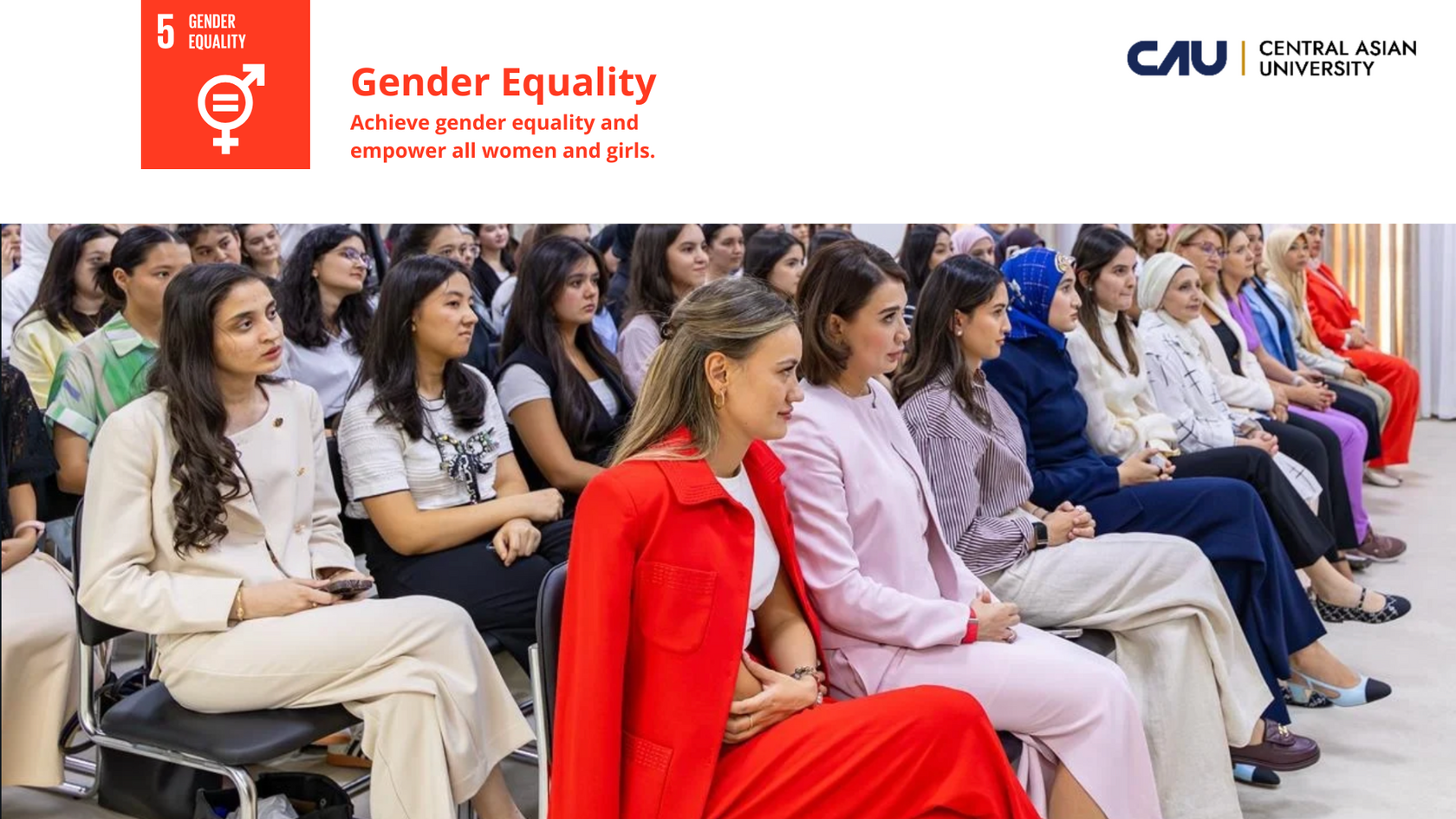
Gender Equality at Central Asian University
CAU’s gender equality framework is implemented through the collaborative efforts of the Human Resources Department, the Women’s Council, and the Student Well-being Office. Together, these departments ensure that all university policies, programs, and activities reflect fairness, transparency, and respect. The university’s vision goes beyond simple gender balance - it aims to empower women through leadership opportunities, equal pay, access to education, and mental well-being initiatives.
CAU demonstrates a strong commitment to gender inclusiveness in education. Nearly 49% of its total student population consists of female students, showing the university’s success in ensuring equal access to academic opportunities. This balance is further reflected in graduation and enrollment rates, confirming the institution’s dedication to maintaining gender parity across all stages of study.
The university also organizes TEDxWomen events, which serve as an empowering platform for women students, faculty, and staff to share their stories of leadership, innovation, and personal growth. These events celebrate women’s achievements and inspire dialogue on empowerment and equality within and beyond the campus.
Gender equality is also embedded in CAU’s employment and human resource policies. The university enforces a strict Equal Employment Opportunity Policy that guarantees fairness in recruitment, promotion, and leadership appointments.
The analysis of 2023–2024 data highlights a notable increase in female staff participation - full-time female employees grew from 51 in 2023 to 184 in 2024, while women in well-paid positions rose from 31% to 38%. These figures reflect the university’s ongoing success in breaking barriers and promoting female leadership across departments.
Additionally, CAU ensures that no gender-based pay gap exists; salaries are standardized across positions, and equal pay for equal work is a core principle of the institution.
Central Asian University strictly adheres to the Labour Code of the Republic of Uzbekistan, ensuring full protection of parental rights for both female and male employees.
Female employees receive fully paid maternity leave, while male employees are entitled to paternity leave to care for their newborns. During these periods, employment rights and positions remain fully protected. These policies reflect CAU’s dedication to supporting families and ensuring gender equality in both personal and professional life.
The university provides comprehensive psychological and well-being services for both students and staff. A professional on-campus psychologist offers counseling sessions, mental health workshops, and self-care programs focused on emotional balance and stress management.
The psychologist works closely with the Women’s Council and the Student Well-being Department to provide gender-sensitive support, helping women overcome challenges, build confidence, and maintain a healthy work-life balance.
In support of women’s economic empowerment, CAU launched the “Ayol by CAU” initiative, a pioneering program inspired by the Grameen Bank model. The initiative offers free microfinance training and mentorship for women entrepreneurs, promoting financial literacy and self-sufficiency.
Through a 10-day offline training program, participants learn business management, marketing, digital sales strategies, and communication skills. So far, 170 women have completed the training, and 45 have successfully received microfinance funding to start or expand their businesses.
The program also integrates psychological support, ensuring holistic development that combines financial, emotional, and social empowerment. It stands as a model for higher education institutions promoting gender equality and sustainable development.
CAU strongly supports gender equality in sports and recreation. All university members — students, faculty, and staff - have free access to the sports hall, swimming pool, gym, volleyball and football fields, and recreational zones.
To ensure comfort and inclusivity, CAU provides separate training hours and gender-specific trainers, creating a safe, respectful, and supportive environment for everyone. These facilities promote teamwork, wellness, and confidence while encouraging both men and women to engage in physical activities equally.
The Women’s Council at CAU plays a central role in advancing gender-related initiatives on campus. It organizes mentorship programs, leadership training sessions, and awareness campaigns promoting professional growth and gender equality.
Working closely with the HR Department, the Council ensures female participation in decision-making processes and contributes to institutional policy development. Its annual TEDxWomen event serves as a signature platform to showcase women’s achievements in education, science, and community development, inspiring innovation and leadership among students and staff alike.