
The Sustainability Lab by Central Asian University represents a cornerstone of the university’s institutional commitment to sustainable development and alignment with the United Nations Sustainable Development Goals (SDGs). Established under the Research and Innovation Center, the Lab functions as the central platform for coordinating sustainability-focused initiatives, projects, and interdisciplinary research across all faculties.
The Lab’s mission is to cultivate a culture of sustainability within the university community by promoting evidence-based research, responsible resource management, and collaborative engagement among students, faculty, and external partners. It serves as a hub for developing innovative solutions to environmental and social challenges through academic inquiry and practical application.
Key focus areas of the Sustainability Lab include the design and implementation of a university-wide Sustainability Action Plan, the advancement of green campus initiatives, and research support in fields such as renewable energy, waste management, sustainable infrastructure, and climate resilience. In addition, the Lab actively facilitates seminars, workshops, and student–faculty research collaborations, strengthening CAU’s contribution to sustainability both locally and globally.
The Lab’s mission is to cultivate a culture of sustainability within the university community by promoting evidence-based research, responsible resource management, and collaborative engagement among students, faculty, and external partners. It serves as a hub for developing innovative solutions to environmental and social challenges through academic inquiry and practical application.
Key focus areas of the Sustainability Lab include the design and implementation of a university-wide Sustainability Action Plan, the advancement of green campus initiatives, and research support in fields such as renewable energy, waste management, sustainable infrastructure, and climate resilience. In addition, the Lab actively facilitates seminars, workshops, and student–faculty research collaborations, strengthening CAU’s contribution to sustainability both locally and globally.


Why CAU needs this LAB now?
What problem are we solving?
CAU SDG Innovation Lab
Uzbekistan’s Green Economy Strategy 2019-2030
Global Universities (Oxford, Harvard, Stanford) run SDG labs
CAU can be the first in Central Asia
Research rarely reaches businesses or communities
Students need real employability skills (consulting, analysis, leadership)
CAU must stand out in the higher education market
Students need real employability skills (consulting, analysis, leadership)
CAU must stand out in the higher education market
by Central Asian University
Working in close partnership with the Student Council (SC), the Lab also supports student-led sustainability initiatives under the Sustainable Development Plan of Action, which integrates sustainability principles into academic life, wellbeing programs, and community engagement activities.
In the long term, the Sustainability Lab by CAU aims to evolve into a regional center of excellence for sustainability research and innovation, driving transformative impact across Central Asia through interdisciplinary collaboration, education, and evidence-based policy development.


In line with CAU’s broader mission to advance the Sustainable Development Goals through education and awareness, the university hosted a guest lecture by Dr. Ceren Güven Güres, UN Women Country Manager in Uzbekistan. The session took place on December 17, from 1:30 PM to 2:30 PM, in Room A304, and was moderated by Associate Professor H. Elif Kutlugun. Under the topic “Global Gender Equality and Gender Equality in Uzbekistan,” the lecture explored the importance of gender equality, its global implications, and the challenges and progress within Uzbekistan. This event provided students and faculty with valuable insights into international strategies and national initiatives promoting gender equity, reinforcing CAU’s commitment to inclusive and sustainable development.


Sustainability Lab by CAU
The Lab represents a cornerstone of the university’s institutional commitment to sustainable development and alignment with the United Nations Sustainable Development Goals (SDGs).
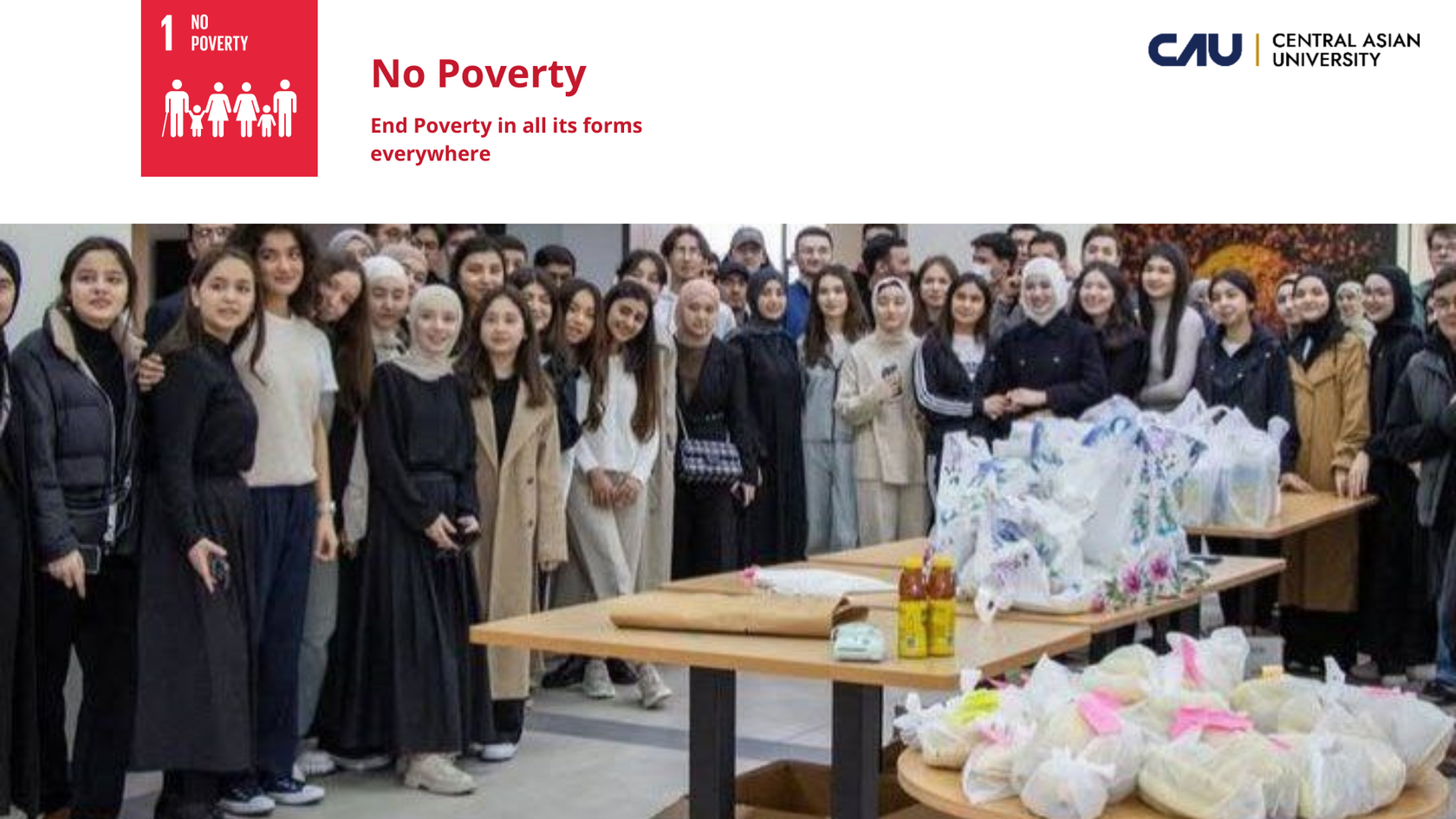
No Poverty - SDG 1
1.1.1 - Contribution to Poverty Reduction through Education and Community Engagement
CAU’s Commitment to Poverty Alleviation
Central Asian University is committed to reducing poverty through education, research, and community initiatives, in alignment with the United Nations Sustainable Development Goal 1 - No Poverty. The University recognizes poverty as a multidimensional issue involving limited access to education, healthcare, and opportunities.
CAU promotes social responsibility across its academic and community programs, empowering students and staff to contribute toward inclusive growth and sustainable development.
CAU’s Commitment to Poverty Alleviation
Central Asian University is committed to reducing poverty through education, research, and community initiatives, in alignment with the United Nations Sustainable Development Goal 1 - No Poverty. The University recognizes poverty as a multidimensional issue involving limited access to education, healthcare, and opportunities.
CAU promotes social responsibility across its academic and community programs, empowering students and staff to contribute toward inclusive growth and sustainable development.
1.2.1 - Research and Innovation for Poverty Reduction
Research-Based Approaches to Social Equity
CAU researchers develop innovative methods to assess and address poverty beyond income-based measures. Studies such as “Measuring Non-Monetary Poverty via Machine Learning and Neutrosophic Method” apply artificial intelligence and data-driven models to identify social inequalities and guide fair policy decisions.
These initiatives strengthen CAU’s contribution to SDG 1 (No Poverty) and SDG 10 (Reduced Inequalities) through evidence-based and inclusive solutions.
Research-Based Approaches to Social Equity
CAU researchers develop innovative methods to assess and address poverty beyond income-based measures. Studies such as “Measuring Non-Monetary Poverty via Machine Learning and Neutrosophic Method” apply artificial intelligence and data-driven models to identify social inequalities and guide fair policy decisions.
These initiatives strengthen CAU’s contribution to SDG 1 (No Poverty) and SDG 10 (Reduced Inequalities) through evidence-based and inclusive solutions.
1.3.1- Community and Social Outreach Programmes
Supporting Vulnerable Groups
CAU organizes donation and volunteering campaigns to assist low-income families, elderly care homes (Mehr va Sahovat Uyi), and children’s centers (Bolalar Uyi). Students and staff contribute essential goods, food, and educational materials, fostering empathy and civic responsibility.
CAU students also participate in outreach programs distributing meals and necessities to those in need, reflecting the University’s values of compassion and solidarity.
Supporting Vulnerable Groups
CAU organizes donation and volunteering campaigns to assist low-income families, elderly care homes (Mehr va Sahovat Uyi), and children’s centers (Bolalar Uyi). Students and staff contribute essential goods, food, and educational materials, fostering empathy and civic responsibility.
CAU students also participate in outreach programs distributing meals and necessities to those in need, reflecting the University’s values of compassion and solidarity.
1.4.1 - Inclusive Cultural and Social Support Activities
Ramadan Iftar and Campus Solidarity
Each year, CAU hosts a free Ramadan Iftar program for students, staff, and community members. This initiative promotes unity, generosity, and inclusion- supporting individuals who may face financial challenges and reinforcing CAU’s dedication to community welfare. Through these integrated efforts in research, education, and social engagement, Central Asian University continues to advance the goals of SDG 1 – No Poverty, contributing to a more equitable and compassionate society.
Ramadan Iftar and Campus Solidarity
Each year, CAU hosts a free Ramadan Iftar program for students, staff, and community members. This initiative promotes unity, generosity, and inclusion- supporting individuals who may face financial challenges and reinforcing CAU’s dedication to community welfare. Through these integrated efforts in research, education, and social engagement, Central Asian University continues to advance the goals of SDG 1 – No Poverty, contributing to a more equitable and compassionate society.
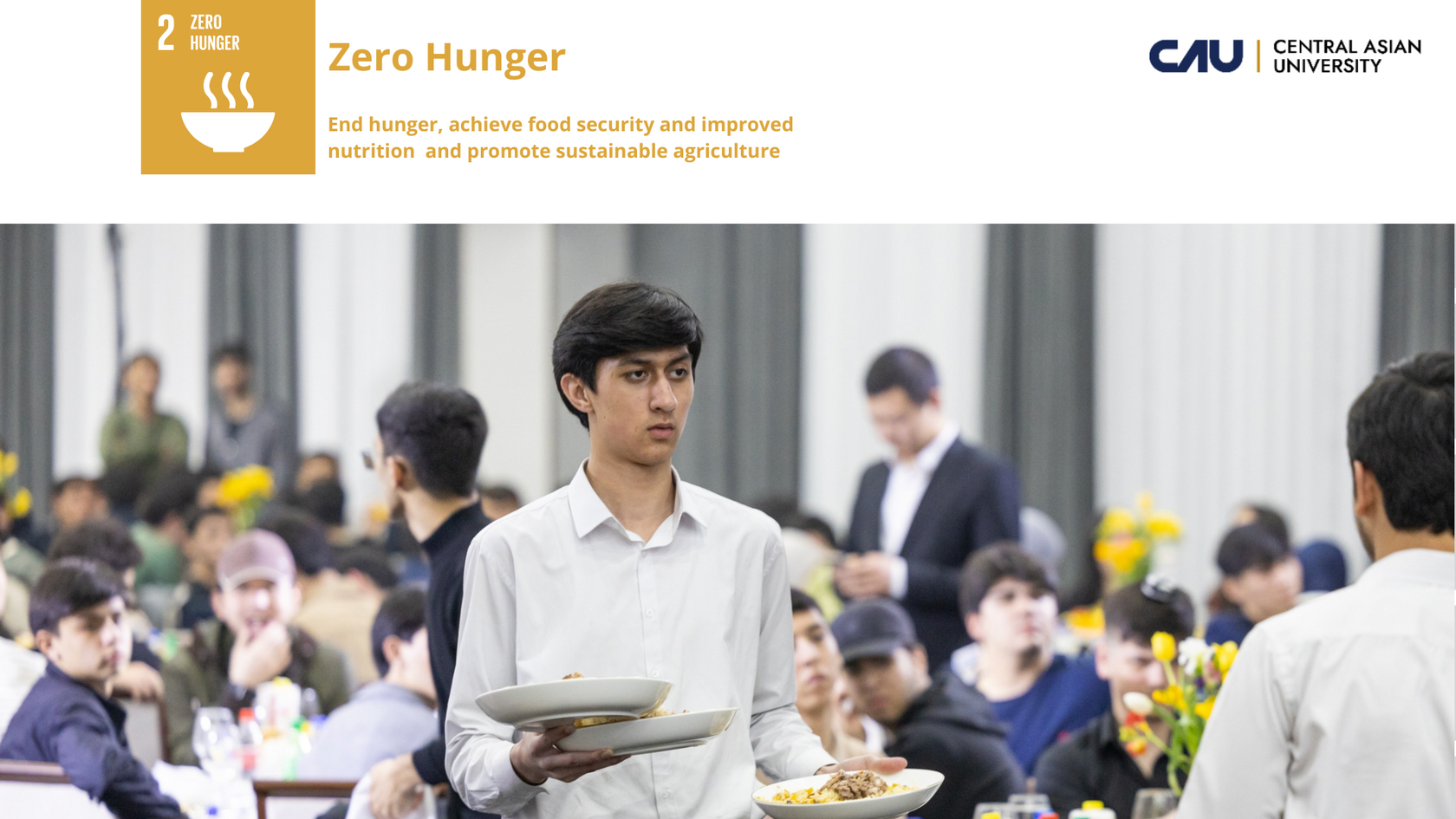
Zero Hunger- SDG 2
2.2.1 - Measurement of Food Waste Generated from University Food Services
Food Waste Management at Central Asian University
The CAU Cafeteria is a modern two-story building designed for comfort and convenience, offering a welcoming space where students and staff can eat, relax, or study. It serves over 50 dishes daily, including salads, soups, hot meals, vegetarian and vegan options, desserts, and drinks—all prepared with fresh, locally sourced ingredients.
CAU promotes healthy eating and sustainability through balanced meals, eco-friendly materials, and efforts to reduce food waste. In 2025, the university reduced total organic waste from 82 tons to 74 tons, thanks to food-waste segregation, composting, and awareness campaigns.
Food waste dropped from 38 tons to 34 tons, mainly due to portion control and partnerships that redistribute edible leftovers. Leaf and landscaping waste also decreased, and more waste was reused (20 tons), down-cycled (6 tons), or upcycled (3 tons) into compost for campus green areas.
After each meal, canteen staff separate organic and non-organic waste, ensuring proper collection and composting. These actions demonstrate CAU’s commitment to sustainability and responsible waste management.
🔗 Read more
Food Waste Management at Central Asian University
The CAU Cafeteria is a modern two-story building designed for comfort and convenience, offering a welcoming space where students and staff can eat, relax, or study. It serves over 50 dishes daily, including salads, soups, hot meals, vegetarian and vegan options, desserts, and drinks—all prepared with fresh, locally sourced ingredients.
CAU promotes healthy eating and sustainability through balanced meals, eco-friendly materials, and efforts to reduce food waste. In 2025, the university reduced total organic waste from 82 tons to 74 tons, thanks to food-waste segregation, composting, and awareness campaigns.
Food waste dropped from 38 tons to 34 tons, mainly due to portion control and partnerships that redistribute edible leftovers. Leaf and landscaping waste also decreased, and more waste was reused (20 tons), down-cycled (6 tons), or upcycled (3 tons) into compost for campus green areas.
After each meal, canteen staff separate organic and non-organic waste, ensuring proper collection and composting. These actions demonstrate CAU’s commitment to sustainability and responsible waste management.
🔗 Read more
2.2.2.1- Total Food Waste
Annual Measurement of Food Waste on Campus
This indicator measures the total amount of food waste generated by the university’s food services in a given year. It includes all leftover, uneaten, or discarded food from cafeterias, dining halls, and other food outlets on campus.
The total is measured in metric tons and reflects the university’s efforts to monitor and manage food waste. Tracking this data helps identify waste reduction opportunities and supports sustainability initiatives.
Annual Measurement of Food Waste on Campus
This indicator measures the total amount of food waste generated by the university’s food services in a given year. It includes all leftover, uneaten, or discarded food from cafeterias, dining halls, and other food outlets on campus.
The total is measured in metric tons and reflects the university’s efforts to monitor and manage food waste. Tracking this data helps identify waste reduction opportunities and supports sustainability initiatives.
2.2.2.2 - Campus Population
CAU Campus Community Overview
The total campus population at Central Asian University comprises approximately 2,178 students alongside 710 staff members, encompassing academic, administrative, and operational personnel.
This diverse community contributes to a vibrant and dynamic university environment, fostering collaboration, innovation, and growth. Together, students and staff make up the core of CAU’s educational mission, driving academic excellence and supporting the institution’s commitment to sustainable development and inclusive learning.
CAU Campus Community Overview
The total campus population at Central Asian University comprises approximately 2,178 students alongside 710 staff members, encompassing academic, administrative, and operational personnel.
This diverse community contributes to a vibrant and dynamic university environment, fostering collaboration, innovation, and growth. Together, students and staff make up the core of CAU’s educational mission, driving academic excellence and supporting the institution’s commitment to sustainable development and inclusive learning.
2.3.1 - Student Food Insecurity Programme
Student-Led Food Donation Campaigns Supporting Low-Income Families
Throughout the academic year, Central Asian University students actively participate in donation campaigns to support low-income families across Uzbekistan. These campaigns collect and distribute essential food items such as rice, oil, flour, and sugar.
Organized by student clubs with guidance from university mentors, the initiatives involve identifying families in need, coordinating collection points, and delivering food packages.
These efforts not only help reduce food insecurity but also develop students’ leadership, organization, and empathy skills. This programme reflects CAU’s commitment to social equity and sustainable community development, aligning with the United Nations Sustainable Development Goal 2: Zero Hunger.
Student-Led Food Donation Campaigns Supporting Low-Income Families
Throughout the academic year, Central Asian University students actively participate in donation campaigns to support low-income families across Uzbekistan. These campaigns collect and distribute essential food items such as rice, oil, flour, and sugar.
Organized by student clubs with guidance from university mentors, the initiatives involve identifying families in need, coordinating collection points, and delivering food packages.
These efforts not only help reduce food insecurity but also develop students’ leadership, organization, and empathy skills. This programme reflects CAU’s commitment to social equity and sustainable community development, aligning with the United Nations Sustainable Development Goal 2: Zero Hunger.
2.3.2 - Interventions to Prevent or Alleviate Student Hunger
Free Iftar Meals and Affordable Dining for Students
Central Asian University supports students’ nutritional needs by offering free meals for iftar during the holy month of Ramadan, ensuring that students and staff can break their fast with a nutritious and welcoming meal.
In addition, the campus cafeteria provides a wide variety of meals at affordable prices throughout the year, making healthy and balanced food accessible to all students and staff. These initiatives demonstrate the university’s commitment to student well-being and fostering an inclusive campus environment.
Free Iftar Meals and Affordable Dining for Students
Central Asian University supports students’ nutritional needs by offering free meals for iftar during the holy month of Ramadan, ensuring that students and staff can break their fast with a nutritious and welcoming meal.
In addition, the campus cafeteria provides a wide variety of meals at affordable prices throughout the year, making healthy and balanced food accessible to all students and staff. These initiatives demonstrate the university’s commitment to student well-being and fostering an inclusive campus environment.
2.3.3 - Sustainable Food Choices on Campus
Promoting Vegetarian, Vegan, and Sustainable Food Options at CAU
Central Asian University is committed to promoting sustainable and healthy eating habits across campus by offering a wide variety of food options that cater to diverse dietary needs and preferences.
The university’s cafeteria works closely with its partner, Green Food, to provide a range of vegetarian and vegan meals that are both nutritious and environmentally friendly. These meals are thoughtfully prepared to ensure they meet the highest standards of taste and quality, while also supporting sustainability goals by reducing the reliance on animal-based products.
Understanding the importance of catering to different dietary requirements, the university is planning to introduce a special diet food section in the near future. This section will offer meals designed for individuals with specific nutritional needs, such as low-calorie, low-sodium, or allergen-free options.
Moreover, the cafeteria’s second floor offers an expanded menu featuring a variety of choices that include ample vegan and vegetarian options, making it easy for students, faculty, and staff to select meals aligned with their personal values and health goals.
By providing these sustainable food choices, Central Asian University not only supports individual well-being but also contributes to reducing the campus’s overall environmental footprint. These efforts reflect CAU’s dedication to fostering a campus culture that values health, sustainability, and inclusivity in food consumption
Promoting Vegetarian, Vegan, and Sustainable Food Options at CAU
Central Asian University is committed to promoting sustainable and healthy eating habits across campus by offering a wide variety of food options that cater to diverse dietary needs and preferences.
The university’s cafeteria works closely with its partner, Green Food, to provide a range of vegetarian and vegan meals that are both nutritious and environmentally friendly. These meals are thoughtfully prepared to ensure they meet the highest standards of taste and quality, while also supporting sustainability goals by reducing the reliance on animal-based products.
Understanding the importance of catering to different dietary requirements, the university is planning to introduce a special diet food section in the near future. This section will offer meals designed for individuals with specific nutritional needs, such as low-calorie, low-sodium, or allergen-free options.
Moreover, the cafeteria’s second floor offers an expanded menu featuring a variety of choices that include ample vegan and vegetarian options, making it easy for students, faculty, and staff to select meals aligned with their personal values and health goals.
By providing these sustainable food choices, Central Asian University not only supports individual well-being but also contributes to reducing the campus’s overall environmental footprint. These efforts reflect CAU’s dedication to fostering a campus culture that values health, sustainability, and inclusivity in food consumption
2.3.4 - Healthy and Affordable Food Choices for All
Accessible, Nutritious, and Affordable Meals Across Campus
Central Asian University places a strong emphasis on promoting health and well-being by providing a variety of healthy and affordable food options across campus.
The university cafeteria offers a diverse menu that caters to different dietary needs and preferences, including fresh salads, vegetarian and vegan dishes, and balanced hot meals that are carefully prepared each day using fresh, locally sourced ingredients.
Affordability is a key consideration at CAU, with prices structured to be accessible for all members of the university community, including students, faculty, and staff.
By offering reasonably priced meals without compromising on quality, the cafeteria helps to ensure that everyone can maintain a healthy diet without financial strain. Through these efforts, Central Asian University demonstrates its dedication to fostering a supportive campus environment where healthy eating is encouraged and accessible to all.
Accessible, Nutritious, and Affordable Meals Across Campus
Central Asian University places a strong emphasis on promoting health and well-being by providing a variety of healthy and affordable food options across campus.
The university cafeteria offers a diverse menu that caters to different dietary needs and preferences, including fresh salads, vegetarian and vegan dishes, and balanced hot meals that are carefully prepared each day using fresh, locally sourced ingredients.
Affordability is a key consideration at CAU, with prices structured to be accessible for all members of the university community, including students, faculty, and staff.
By offering reasonably priced meals without compromising on quality, the cafeteria helps to ensure that everyone can maintain a healthy diet without financial strain. Through these efforts, Central Asian University demonstrates its dedication to fostering a supportive campus environment where healthy eating is encouraged and accessible to all.
2.3.5 - Interventions to Prevent or Alleviate Staff Hunger
Nutritional Support and Meal Benefits for University Staff
Central Asian University takes an active approach to supporting the nutritional needs of its staff. According to staff employment contracts, operational staff members are provided with free lunch during working days as part of their benefits package. This ensures that essential personnel who support the daily functioning of the university have reliable access to nutritious meals.
For academic and administrative staff, the university allocates a monthly lunch allowance, which helps subsidize their meal costs. This financial support allows these staff members to enjoy healthy and affordable food options without additional financial burden.
Beyond these measures, the campus cafeteria offers a wide variety of meals, including balanced and nutritious options at affordable prices, accessible to all staff members.
The cafeteria emphasizes fresh, locally sourced ingredients and caters to diverse dietary needs, helping promote overall well-being within the university community. These combined initiatives reflect CAU’s commitment to staff welfare and recognize the importance of ensuring all employees have consistent access to healthy and affordable food.
Nutritional Support and Meal Benefits for University Staff
Central Asian University takes an active approach to supporting the nutritional needs of its staff. According to staff employment contracts, operational staff members are provided with free lunch during working days as part of their benefits package. This ensures that essential personnel who support the daily functioning of the university have reliable access to nutritious meals.
For academic and administrative staff, the university allocates a monthly lunch allowance, which helps subsidize their meal costs. This financial support allows these staff members to enjoy healthy and affordable food options without additional financial burden.
Beyond these measures, the campus cafeteria offers a wide variety of meals, including balanced and nutritious options at affordable prices, accessible to all staff members.
The cafeteria emphasizes fresh, locally sourced ingredients and caters to diverse dietary needs, helping promote overall well-being within the university community. These combined initiatives reflect CAU’s commitment to staff welfare and recognize the importance of ensuring all employees have consistent access to healthy and affordable food.
2.4.1 - Number of Graduates
CAU 2025 Graduates: Fostering Diversity and Academic Excellence Across Faculties
In 2025, Central Asian University celebrated the successful graduation of students from a wide range of academic faculties, reflecting both the diversity and growth of the university community.
These graduation figures highlight CAU’s commitment to gender inclusivity, academic excellence, and the development of skilled professionals across diverse disciplines. The university continues to foster an environment where students of all backgrounds can thrive and succeed in their chosen fields.
CAU 2025 Graduates: Fostering Diversity and Academic Excellence Across Faculties
In 2025, Central Asian University celebrated the successful graduation of students from a wide range of academic faculties, reflecting both the diversity and growth of the university community.
- Accounting & Finance: 26 graduates (15 male, 11 female)
- English Language Teaching and Educational Management (ELTEM): 127 graduates (9 male, 118 female)
- Architecture and Design: 12 graduates (5 male, 7 female)
- Economics: 19 graduates (12 male, 7 female)
- Computer Science: 41 graduates (30 male, 11 female)
- International Business: 20 graduates (8 male, 12 female)
- Medical School: 113 graduates (50 male, 63 female)
These graduation figures highlight CAU’s commitment to gender inclusivity, academic excellence, and the development of skilled professionals across diverse disciplines. The university continues to foster an environment where students of all backgrounds can thrive and succeed in their chosen fields.
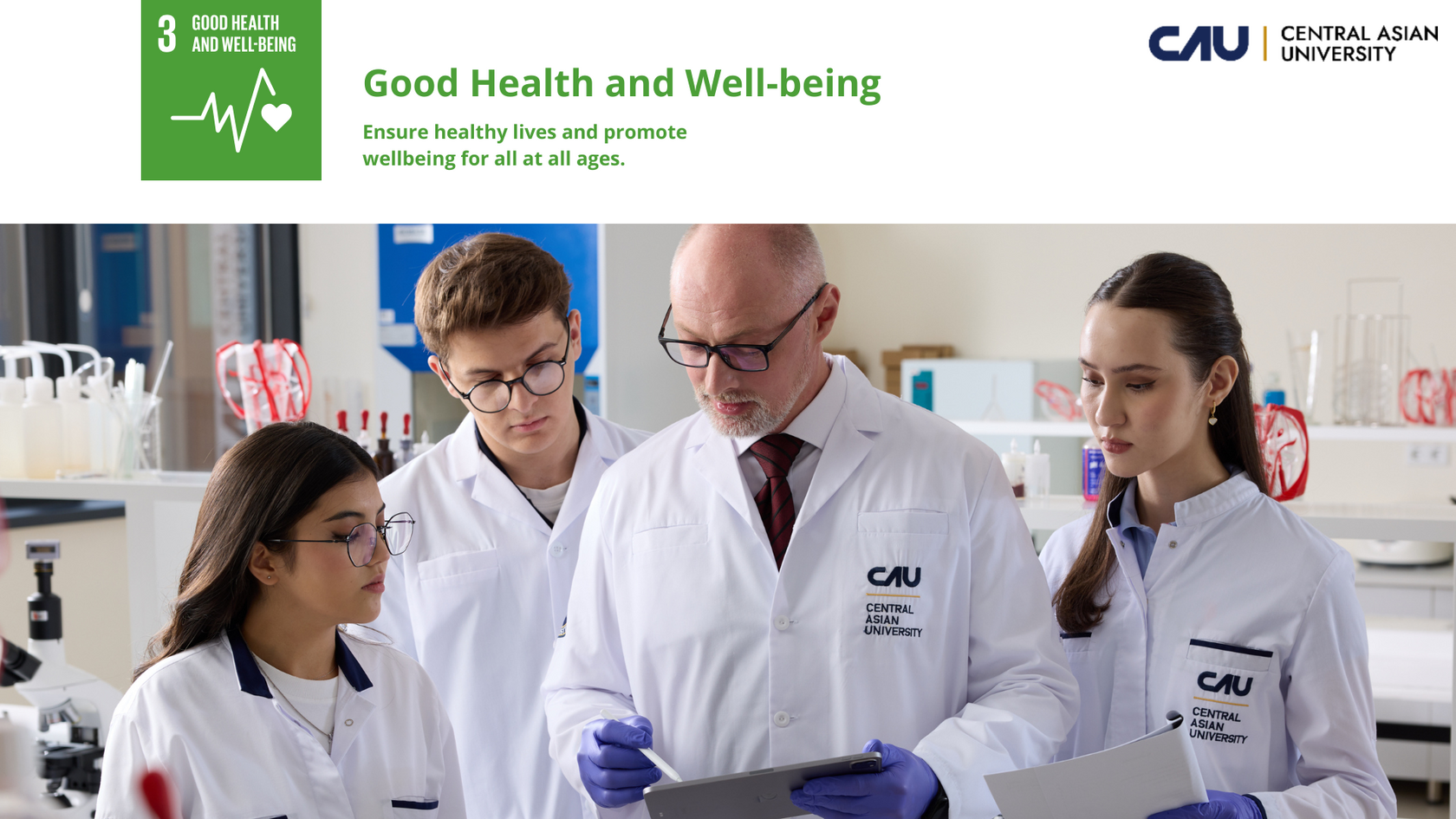
Good Health and Well-being SDG 3
3.2.1 - Number of Graduates
In 2025, Central Asian University proudly celebrated the graduation of students from a diverse range of academic faculties, marking another significant milestone in the institution’s growth and commitment to quality education. The university’s graduating class represented a wide spectrum of disciplines - including Accounting and Finance, English Language Teaching and Educational Management (ELTEM), Architecture and Design, Economics, Computer Science, International Business, and Medicine - demonstrating CAU’s role as a multidisciplinary hub for higher learning in Uzbekistan.
The data from the 2025 graduation highlights both the expansion of academic programs and the university’s emphasis on inclusivity and gender balance. Each faculty contributed to nurturing skilled professionals equipped with the theoretical knowledge, practical expertise, and ethical values required to succeed in their chosen careers. A notable aspect of this year’s graduating class was the strong representation of female students, particularly in education, international business, and medicine- reflecting CAU’s ongoing commitment to empowering women in higher education and professional fields.
These achievements underscore the university’s dedication to producing graduates who are not only academically competent but also socially responsible and globally minded. Through a blend of modern teaching methods, international collaborations, and experiential learning opportunities, CAU continues to prepare its students to contribute meaningfully to their communities and to the broader social and economic development of Uzbekistan and the Central Asian region.
In 2025, Central Asian University proudly celebrated the graduation of students from a diverse range of academic faculties, marking another significant milestone in the institution’s growth and commitment to quality education. The university’s graduating class represented a wide spectrum of disciplines - including Accounting and Finance, English Language Teaching and Educational Management (ELTEM), Architecture and Design, Economics, Computer Science, International Business, and Medicine - demonstrating CAU’s role as a multidisciplinary hub for higher learning in Uzbekistan.
The data from the 2025 graduation highlights both the expansion of academic programs and the university’s emphasis on inclusivity and gender balance. Each faculty contributed to nurturing skilled professionals equipped with the theoretical knowledge, practical expertise, and ethical values required to succeed in their chosen careers. A notable aspect of this year’s graduating class was the strong representation of female students, particularly in education, international business, and medicine- reflecting CAU’s ongoing commitment to empowering women in higher education and professional fields.
These achievements underscore the university’s dedication to producing graduates who are not only academically competent but also socially responsible and globally minded. Through a blend of modern teaching methods, international collaborations, and experiential learning opportunities, CAU continues to prepare its students to contribute meaningfully to their communities and to the broader social and economic development of Uzbekistan and the Central Asian region.
3.2.2 - Number of Graduates in Health Professions
Preparing Competent Healthcare Professionals for the Future
In 2025, Central Asian University’s Medical School celebrated the graduation of 113 students specializing in health professions, including 50 male and 63 female graduates. This strong female representation highlights CAU’s commitment to gender inclusivity in medical education.
These graduates completed rigorous programs designed to equip them with essential clinical knowledge, practical skills, and ethical understanding required to serve effectively in the healthcare sector. Through continuous curriculum development, hands-on training, and community-focused initiatives, CAU ensures its medical professionals are well-prepared to address contemporary health challenges and promote sustainable well-being within Uzbekistan and beyond.
Preparing Competent Healthcare Professionals for the Future
In 2025, Central Asian University’s Medical School celebrated the graduation of 113 students specializing in health professions, including 50 male and 63 female graduates. This strong female representation highlights CAU’s commitment to gender inclusivity in medical education.
These graduates completed rigorous programs designed to equip them with essential clinical knowledge, practical skills, and ethical understanding required to serve effectively in the healthcare sector. Through continuous curriculum development, hands-on training, and community-focused initiatives, CAU ensures its medical professionals are well-prepared to address contemporary health challenges and promote sustainable well-being within Uzbekistan and beyond.
3.3.1- Collaborations with Health Institutions
Advancing Health and Wellbeing Through Strategic Partnerships
Central Asian University actively partners with leading local, national, and international health institutions to enhance healthcare education, research, and service delivery. These collaborations are vital to CAU’s mission of improving health and wellbeing outcomes through innovation, training, and global knowledge exchange.
One of CAU’s landmark collaborations is with the Cleveland Clinic under the Cleveland Clinic Connected program. This partnership is pioneering healthcare advancement in Central Asia through the development of the Central Asian University Hospital - a state-of-the-art regional center of excellence integrating clinical care, medical education, and research.
The hospital will include:
Cleveland Clinic provides expert consultation on hospital design, clinical governance, and staff training, ensuring operations meet international standards of quality and patient safety.
In addition, CAU maintains a strategic, long-term partnership with Roche Diagnostics, a global leader in laboratory and clinical testing technologies. This collaboration enables CAU to incorporate automated diagnostic systems, digital laboratory tools, and Roche’s Navify platform for clinical decision support into its educational and clinical programs.
This partnership allows students, residents, and healthcare professionals to train with cutting-edge technology used in top hospitals worldwide, improving diagnostic accuracy and patient outcomes. Roche further supports CAU’s academic development through training workshops, expert consultations, and capacity-building initiatives for faculty and medical staff.
Moreover, CAU organizes prominent international events such as the International Dental Olympiad, which attracts outstanding dental students and professionals from multiple countries. This event fosters academic excellence, professional development, and cross-border collaboration in dentistry, further elevating CAU’s role in advancing global health standards.
Through these initiatives and partnerships, Central Asian University continues to transform healthcare education and delivery fostering innovation and contributing to long-term health and wellbeing improvements across Uzbekistan and the broader Central Asian region.
Advancing Health and Wellbeing Through Strategic Partnerships
Central Asian University actively partners with leading local, national, and international health institutions to enhance healthcare education, research, and service delivery. These collaborations are vital to CAU’s mission of improving health and wellbeing outcomes through innovation, training, and global knowledge exchange.
One of CAU’s landmark collaborations is with the Cleveland Clinic under the Cleveland Clinic Connected program. This partnership is pioneering healthcare advancement in Central Asia through the development of the Central Asian University Hospital - a state-of-the-art regional center of excellence integrating clinical care, medical education, and research.
The hospital will include:
- 120 inpatient beds
- 8 operating rooms
- Specialized departments in oncology, pediatrics, women’s health, internal medicine, and cardiovascular care
- A maternity unit and fully digital diagnostic center
Cleveland Clinic provides expert consultation on hospital design, clinical governance, and staff training, ensuring operations meet international standards of quality and patient safety.
In addition, CAU maintains a strategic, long-term partnership with Roche Diagnostics, a global leader in laboratory and clinical testing technologies. This collaboration enables CAU to incorporate automated diagnostic systems, digital laboratory tools, and Roche’s Navify platform for clinical decision support into its educational and clinical programs.
This partnership allows students, residents, and healthcare professionals to train with cutting-edge technology used in top hospitals worldwide, improving diagnostic accuracy and patient outcomes. Roche further supports CAU’s academic development through training workshops, expert consultations, and capacity-building initiatives for faculty and medical staff.
Moreover, CAU organizes prominent international events such as the International Dental Olympiad, which attracts outstanding dental students and professionals from multiple countries. This event fosters academic excellence, professional development, and cross-border collaboration in dentistry, further elevating CAU’s role in advancing global health standards.
Through these initiatives and partnerships, Central Asian University continues to transform healthcare education and delivery fostering innovation and contributing to long-term health and wellbeing improvements across Uzbekistan and the broader Central Asian region.
3.3.2 - Delivery of Community Outreach Programmes and Projects to Promote Health and Wellbeing
Central Asian University actively delivers a wide range of outreach programmes and projects aimed at improving health and wellbeing in the local community. These initiatives often involve student volunteering and collaborative efforts with faculty and community partners, addressing critical topics such as hygiene, nutrition, family planning, sports and exercise, and healthy aging.
Through student-led clubs and university-supported campaigns, CAU organizes workshops and awareness sessions that educate community members about proper hygiene practices, balanced nutrition, and preventive health measures. These outreach activities target diverse groups, including schoolchildren, youth, elderly populations, and underserved families, fostering healthier lifestyles and improving public health outcomes.
Moreover, CAU integrates sports and physical activity promotion within its outreach framework, encouraging community participation in fitness programs and organized sports events. These efforts not only support physical wellbeing but also strengthen social cohesion and mental health among participants.
The university’s approach to community health outreach aligns with global best practices and Sustainable Development Goal 3 - Good Health and Well-being - by addressing multiple dimensions of health through education, prevention, and active engagement. This holistic model equips community members with the knowledge and resources needed to make informed health decisions, while simultaneously providing students with valuable experiential learning opportunities that develop leadership, empathy, and organizational skills.
Central Asian University actively delivers a wide range of outreach programmes and projects aimed at improving health and wellbeing in the local community. These initiatives often involve student volunteering and collaborative efforts with faculty and community partners, addressing critical topics such as hygiene, nutrition, family planning, sports and exercise, and healthy aging.
Through student-led clubs and university-supported campaigns, CAU organizes workshops and awareness sessions that educate community members about proper hygiene practices, balanced nutrition, and preventive health measures. These outreach activities target diverse groups, including schoolchildren, youth, elderly populations, and underserved families, fostering healthier lifestyles and improving public health outcomes.
Moreover, CAU integrates sports and physical activity promotion within its outreach framework, encouraging community participation in fitness programs and organized sports events. These efforts not only support physical wellbeing but also strengthen social cohesion and mental health among participants.
The university’s approach to community health outreach aligns with global best practices and Sustainable Development Goal 3 - Good Health and Well-being - by addressing multiple dimensions of health through education, prevention, and active engagement. This holistic model equips community members with the knowledge and resources needed to make informed health decisions, while simultaneously providing students with valuable experiential learning opportunities that develop leadership, empathy, and organizational skills.
3.3.3 - Sharing Sports Facilities with the Local Community
Central Asian University demonstrates its strong commitment to health and wellbeing by providing free access to all sports facilities for both students and staff. Recognizing the vital role of physical activity in maintaining mental and physical health, CAU ensures that its entire university community can use its extensive sports infrastructure without any cost barriers.
Beyond serving students and staff, CAU also generously shares its modern and fully equipped sports facilities with the local community, including schools, sports clubs, and the general public. Access for the wider community is provided free of charge during designated hours and for specific events, reinforcing the university’s role as a regional hub for health promotion and active living.
Key sports facilities available to students, staff, and the community include:
CAU regularly collaborates with local schools and organizations by hosting inter-school competitions, training sessions, and health promotion events on campus. These initiatives encourage youth engagement in sports, foster healthy competition, and strengthen community bonds while providing access to high-quality facilities and coaching.
A key example of CAU’s dedication to community sports development is the Maktab Sport Cup 2025, a dynamic multi-sport tournament that brought together around 2,000 young athletes from Uzbekistan, Kazakhstan, Kyrgyzstan, and Tajikistan. The event, held on CAU’s campus during the autumn break, featured athletics, mini-football, volleyball, basketball, table tennis, tennis, chess, swimming, and e-sports competitions.
The tournament energized the university and local community with enthusiastic participation, teamwork, and a celebration of youth sportsmanship. The three-day event culminated in a grand final and award ceremony, highlighting CAU’s commitment to fostering leadership, healthy lifestyles, and regional cooperation through sport.
By offering free sports facility access to students and staff and opening these facilities to the local community under supportive terms, Central Asian University helps remove barriers to physical activity, promotes wellness, and builds social cohesion. This inclusive approach aligns with CAU’s broader mission to advance Sustainable Development Goal 3 - Good Health and Well-being - positioning the university as a leader in regional health promotion and community development.
Central Asian University demonstrates its strong commitment to health and wellbeing by providing free access to all sports facilities for both students and staff. Recognizing the vital role of physical activity in maintaining mental and physical health, CAU ensures that its entire university community can use its extensive sports infrastructure without any cost barriers.
Beyond serving students and staff, CAU also generously shares its modern and fully equipped sports facilities with the local community, including schools, sports clubs, and the general public. Access for the wider community is provided free of charge during designated hours and for specific events, reinforcing the university’s role as a regional hub for health promotion and active living.
Key sports facilities available to students, staff, and the community include:
- Indoor and Outdoor Football Fields: Used for training, friendly matches, school tournaments, and community leagues to promote football skills and teamwork.
- Tennis and Volleyball Courts: Available for recreational and competitive use for players of all ages and levels.
- Baseball Field: Supporting local teams and encouraging participation in this growing sport.
- Fully Equipped Gymnasium: Featuring professional-grade machines for strength training, cardio workouts, and rehabilitation exercises. The gym hosts fitness classes and offers individual workout spaces.
- Indoor Swimming Pool: Open year-round for swim lessons, club practices, and recreational swimming, promoting cardiovascular health and endurance.
CAU regularly collaborates with local schools and organizations by hosting inter-school competitions, training sessions, and health promotion events on campus. These initiatives encourage youth engagement in sports, foster healthy competition, and strengthen community bonds while providing access to high-quality facilities and coaching.
A key example of CAU’s dedication to community sports development is the Maktab Sport Cup 2025, a dynamic multi-sport tournament that brought together around 2,000 young athletes from Uzbekistan, Kazakhstan, Kyrgyzstan, and Tajikistan. The event, held on CAU’s campus during the autumn break, featured athletics, mini-football, volleyball, basketball, table tennis, tennis, chess, swimming, and e-sports competitions.
The tournament energized the university and local community with enthusiastic participation, teamwork, and a celebration of youth sportsmanship. The three-day event culminated in a grand final and award ceremony, highlighting CAU’s commitment to fostering leadership, healthy lifestyles, and regional cooperation through sport.
By offering free sports facility access to students and staff and opening these facilities to the local community under supportive terms, Central Asian University helps remove barriers to physical activity, promotes wellness, and builds social cohesion. This inclusive approach aligns with CAU’s broader mission to advance Sustainable Development Goal 3 - Good Health and Well-being - positioning the university as a leader in regional health promotion and community development.
3.3.4 - Student Access to Sexual and Reproductive Health-Care Services and Education
Central Asian University provides students with access to sexual and reproductive health-care information and education through regular workshops and awareness sessions. These programs, conducted by qualified professionals, cover important topics such as safe sex practices, family planning, prevention of sexually transmitted infections, and overall reproductive health.
Central Asian University provides students with access to sexual and reproductive health-care information and education through regular workshops and awareness sessions. These programs, conducted by qualified professionals, cover important topics such as safe sex practices, family planning, prevention of sexually transmitted infections, and overall reproductive health.
The university collaborates with organizations like HIV and AIDS to deliver up-to-date, accurate, and culturally sensitive information. These initiatives ensure that students are well-informed and empowered to make responsible decisions regarding their sexual and reproductive wellbeing. By offering these educational services, CAU demonstrates its commitment to student health and wellbeing, fostering a supportive environment where students can access reliable information in a confidential and respectful setting.
3.3.5 - Student Access to Mental Health Support
Central Asian University prioritizes the mental health and wellbeing of its students by providing comprehensive access to mental health support services on campus. A qualified psychologist is available for confidential one-on-one counseling sessions to help students manage stress, anxiety, and personal challenges.
In addition to individual counseling, the university organizes regular mental health awareness programs and workshops to promote emotional resilience, stress management, and overall psychological wellbeing. These initiatives aim to create a supportive and inclusive campus environment where students feel comfortable seeking help. Through these dedicated mental health services, CAU ensures that students receive the care and resources necessary to maintain their emotional balance and succeed academically and personally.
Mental Health
Central Asian University prioritizes the mental health and wellbeing of its students by providing comprehensive access to mental health support services on campus. A qualified psychologist is available for confidential one-on-one counseling sessions to help students manage stress, anxiety, and personal challenges.
In addition to individual counseling, the university organizes regular mental health awareness programs and workshops to promote emotional resilience, stress management, and overall psychological wellbeing. These initiatives aim to create a supportive and inclusive campus environment where students feel comfortable seeking help. Through these dedicated mental health services, CAU ensures that students receive the care and resources necessary to maintain their emotional balance and succeed academically and personally.
Mental Health
3.3.6 - Smoke-Free Policy
Central Asian University enforces a strict smoke-free policy across its entire campus. Smoking is completely prohibited inside all university buildings and indoor areas to ensure a healthy and safe environment for students, staff, and visitors.
Clear signage, reminders, and logos indicating the smoking restrictions are prominently displayed throughout the campus to support compliance. Any violation of the smoke-free policy is taken seriously, and individuals found smoking in prohibited areas may face disciplinary actions according to university regulations. These measures reflect CAU’s strong commitment to promoting clean air and protecting the wellbeing of its entire community.
Central Asian University enforces a strict smoke-free policy across its entire campus. Smoking is completely prohibited inside all university buildings and indoor areas to ensure a healthy and safe environment for students, staff, and visitors.
Clear signage, reminders, and logos indicating the smoking restrictions are prominently displayed throughout the campus to support compliance. Any violation of the smoke-free policy is taken seriously, and individuals found smoking in prohibited areas may face disciplinary actions according to university regulations. These measures reflect CAU’s strong commitment to promoting clean air and protecting the wellbeing of its entire community.
3.3.7 - Staff Access to Mental Health Support
Central Asian University is committed to supporting the mental health and wellbeing of its staff by offering free access to self-help resources and training sessions. These programs are designed to help staff manage stress, enhance resilience, and maintain a healthy work-life balance.
Through regular workshops, seminars, and online resources, staff members receive practical tools and guidance to support their mental wellbeing. This proactive approach fosters a positive and supportive workplace environment, ensuring that employees feel valued and cared for.
Central Asian University is committed to supporting the mental health and wellbeing of its staff by offering free access to self-help resources and training sessions. These programs are designed to help staff manage stress, enhance resilience, and maintain a healthy work-life balance.
Through regular workshops, seminars, and online resources, staff members receive practical tools and guidance to support their mental wellbeing. This proactive approach fosters a positive and supportive workplace environment, ensuring that employees feel valued and cared for.
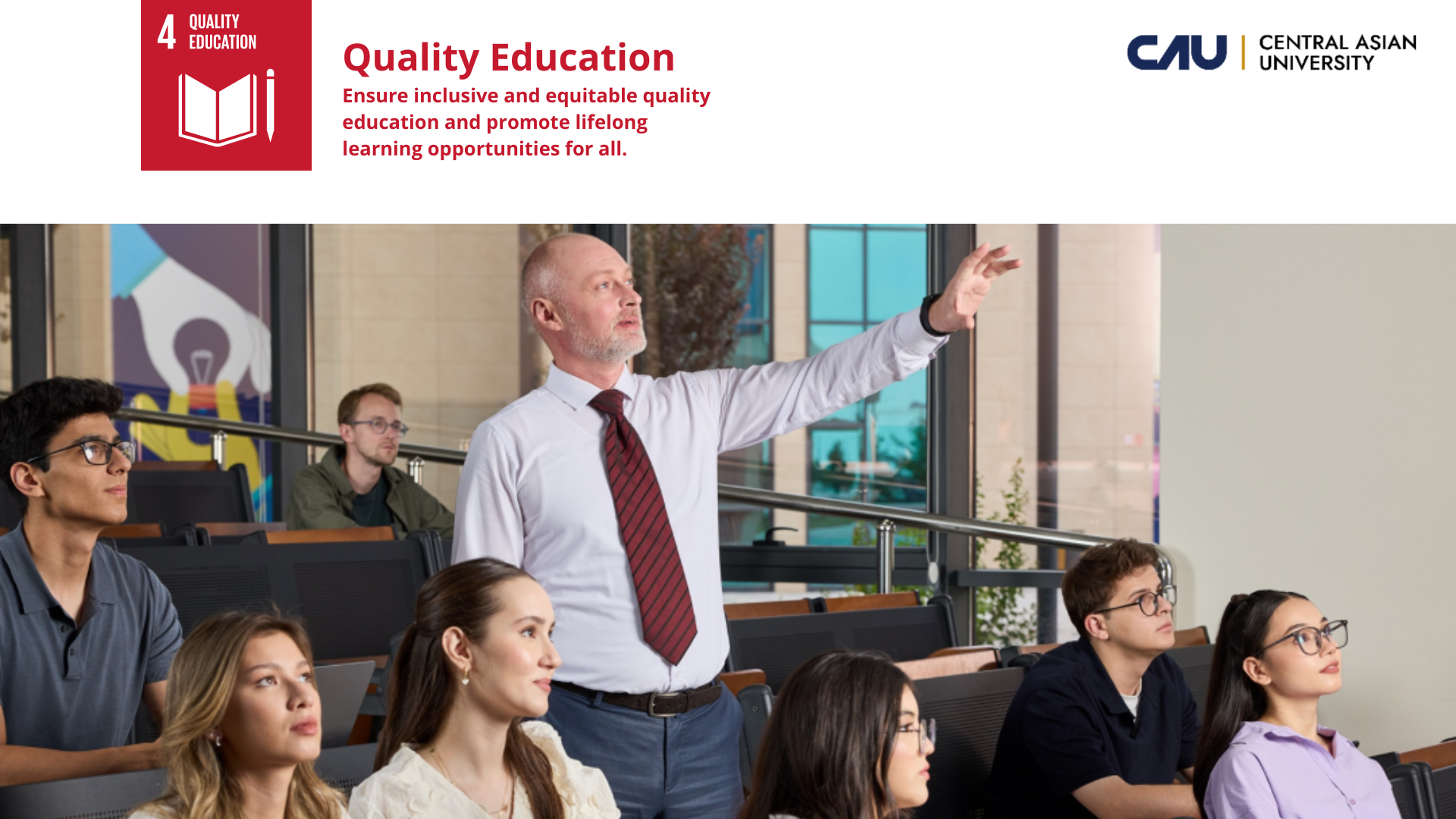
Quality Education - SDG 4
Central Asian University is committed to advancing Sustainable Development Goal 4 (SDG 4): Quality Education by providing inclusive, equitable, and internationally aligned education that equips students with knowledge, skills, and competencies necessary to excel in a globalized world. CAU integrates innovative teaching, interdisciplinary research, and experiential learning to develop responsible, creative, and skilled professionals across various fields.
4.1 High-Quality Academic Programs with Global Standards
CAU offers a wide array of academic programs designed to meet international standards and foster professional excellence:
Established in 2017, the medical program uses a competency-based curriculum combining theoretical foundations with early and continuous clinical exposure. Advanced simulation centers with over 220 patient simulators enable practical skill development, and instruction is delivered by a diverse international faculty. These elements prepare students for medical practice that meets global healthcare demands.
The five-year Doctor of Dental Surgery program begins with a one-year Pre-Dental Foundation Program, building scientific readiness for advanced dental study. Courses are taught entirely in English. The school’s modern facilities include digital dentistry labs, CAD-CAM systems, and simulation units. International partnerships, such as with Thailand’s Chulalongkorn University, enhance research collaboration and student exchanges. CAU organizes the prestigious International Dental Olympiad to cultivate excellence in dental education and professional skills.
Inspired by the Harvard Business School case method, the Business School offers specialized programs in Accounting and Finance, Economics, International Business, Marketing, ELTEM, and PRMM. Equipped with cutting-edge R&D and innovation labs, students engage in entrepreneurial projects and participate in international case competitions. Study tours to European business hubs deepen students’ global perspectives and practical business knowledge.
Offering a Bachelor of Arts in International Hospitality and Tourism Management, this school partners with HTMi Switzerland and industry leaders such as Hilton to provide hands-on education in service excellence, sustainable tourism, and event management. Faculty expertise spans global hospitality markets, preparing students for leadership roles in an evolving industry.
Combining creativity, technology, and sustainability, this school emphasizes studio-based learning and interdisciplinary collaboration. Students’ projects address real-world urban and environmental challenges and are showcased in exhibitions and international festivals, reinforcing CAU’s commitment to socially responsible design education.
Programs in Computer Science, Biomedical Engineering, Industrial Engineering, and Architecture & Design integrate theory with applied research and hands-on projects such as IoT devices, AI systems, and robotics. Students benefit from international training opportunities that build global competencies.
CAU offers a wide array of academic programs designed to meet international standards and foster professional excellence:
- School of Medicine:
Established in 2017, the medical program uses a competency-based curriculum combining theoretical foundations with early and continuous clinical exposure. Advanced simulation centers with over 220 patient simulators enable practical skill development, and instruction is delivered by a diverse international faculty. These elements prepare students for medical practice that meets global healthcare demands.
- Dental School:
The five-year Doctor of Dental Surgery program begins with a one-year Pre-Dental Foundation Program, building scientific readiness for advanced dental study. Courses are taught entirely in English. The school’s modern facilities include digital dentistry labs, CAD-CAM systems, and simulation units. International partnerships, such as with Thailand’s Chulalongkorn University, enhance research collaboration and student exchanges. CAU organizes the prestigious International Dental Olympiad to cultivate excellence in dental education and professional skills.
- Business School:
Inspired by the Harvard Business School case method, the Business School offers specialized programs in Accounting and Finance, Economics, International Business, Marketing, ELTEM, and PRMM. Equipped with cutting-edge R&D and innovation labs, students engage in entrepreneurial projects and participate in international case competitions. Study tours to European business hubs deepen students’ global perspectives and practical business knowledge.
- School of Hospitality Management and Tourism:
Offering a Bachelor of Arts in International Hospitality and Tourism Management, this school partners with HTMi Switzerland and industry leaders such as Hilton to provide hands-on education in service excellence, sustainable tourism, and event management. Faculty expertise spans global hospitality markets, preparing students for leadership roles in an evolving industry.
- School of Architecture and Design:
Combining creativity, technology, and sustainability, this school emphasizes studio-based learning and interdisciplinary collaboration. Students’ projects address real-world urban and environmental challenges and are showcased in exhibitions and international festivals, reinforcing CAU’s commitment to socially responsible design education.
- School of Engineering:
Programs in Computer Science, Biomedical Engineering, Industrial Engineering, and Architecture & Design integrate theory with applied research and hands-on projects such as IoT devices, AI systems, and robotics. Students benefit from international training opportunities that build global competencies.
4.2 Experiential Learning, Research, and Innovation
CAU embeds research and practical application at the core of its educational approach:
CAU embeds research and practical application at the core of its educational approach:
- The CAU Journal of Applied Research fosters interdisciplinary collaboration and provides students with opportunities to engage in meaningful, real-world research addressing healthcare, technology, tourism, business, and education challenges.
- Academic competitions such as the International Dental Olympiad, Business Case Competitions, and the ELT Innovators’ Challenge develop critical thinking, leadership, and teamwork skills.
- Faculty-led projects and student-led startups, such as the Business School’s small-scale entrepreneurial cookie business, exemplify the “learning by doing” philosophy.
- CAU faculty actively publish and present research internationally, advancing knowledge in sustainable tourism, digital health, and engineering innovation.
4.3 Holistic Student Development and Campus Life
CAU emphasizes comprehensive student growth through an active campus life rich with extracurricular and co-curricular activities, recognizing that quality education extends beyond academics:
CAU emphasizes comprehensive student growth through an active campus life rich with extracurricular and co-curricular activities, recognizing that quality education extends beyond academics:
- The university hosts over 20 student clubs, including Football, Volleyball, Tennis, Swimming, Gym, Dance, Music, Art, Debate, Chess, Programming, Cybersecurity, Economics Debate, Research, Volunteers, and more. These clubs promote teamwork, leadership, creativity, and cultural engagement.
- All activities are free and inclusive, ensuring equal access for all students regardless of background, thus supporting diversity and social cohesion.
- Students develop critical 21st-century skills - communication, problem-solving, collaboration, and leadership- through club participation, competitions, and cultural events.
- CAU facilitates practical exposure via student participation in national and international forums such as HoReCa Uzbekistan, United Nations World Tourism Day, and the Hotel Business Forum, connecting academic theory with industry realities.
- Special events like the Kite Flying Competition by the Architecture & Design Department and research exhibitions showcase student creativity and technical mastery, fostering community and peer learning.
- Engagement in clubs and campus initiatives encourages students to become socially responsible, innovative global citizens prepared for lifelong learning and leadership.
4.4 Strategic International Partnerships and Industry Collaboration
CAU strengthens quality education through global and local collaborations:
Through these efforts, Central Asian University demonstrates its unwavering commitment to delivering high-quality, inclusive education that aligns with SDG 4, preparing graduates to meet both local and global challenges with competence, creativity, and social responsibility.
CAU strengthens quality education through global and local collaborations:
- Academic partnerships with institutions such as Chulalongkorn University (Thailand), HTMi Switzerland, Cologne Business School (Germany), and others provide avenues for faculty and student exchanges, joint research, and curricular enhancement.
- Industry alliances with companies like Hilton Hotels, Ernst & Young, PricewaterhouseCoopers, and regional tourism organizations offer mentorship, internships, and career development opportunities.
- CAU actively participates in and hosts international academic and industry events, integrating emerging trends such as AI, VR, and smart technologies in education and professional practice.
- New agreements with national bodies like the Association of Hoteliers support internships, curriculum alignment, and research initiatives that foster innovation and sustainability in hospitality and tourism.
Through these efforts, Central Asian University demonstrates its unwavering commitment to delivering high-quality, inclusive education that aligns with SDG 4, preparing graduates to meet both local and global challenges with competence, creativity, and social responsibility.
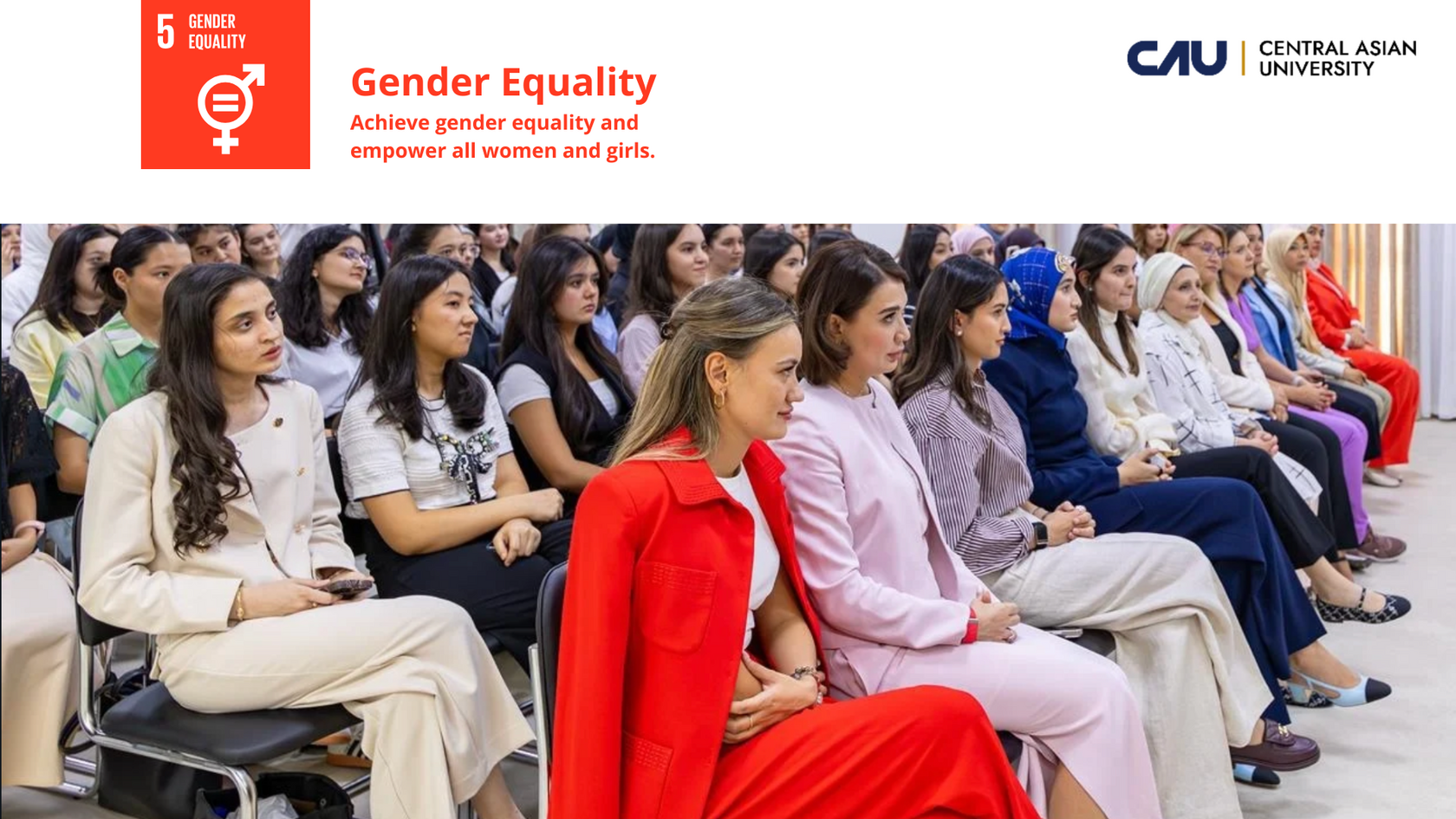
Gender Equality - SDG 5
Central Asian University remains deeply committed to fostering gender equality, inclusion, and empowerment across all aspects of academic, professional, and social life. In alignment with the United Nations Sustainable Development Goal 5- Gender Equality, the university ensures that both women and men are provided with equal opportunities, rights, and support to succeed in their education, careers, and personal development.
CAU’s gender equality framework is implemented through the collaborative efforts of the Human Resources Department, the Women’s Council, and the Student Well-being Office. Together, these departments ensure that all university policies, programs, and activities reflect fairness, transparency, and respect. The university’s vision goes beyond simple gender balance - it aims to empower women through leadership opportunities, equal pay, access to education, and mental well-being initiatives.
CAU’s gender equality framework is implemented through the collaborative efforts of the Human Resources Department, the Women’s Council, and the Student Well-being Office. Together, these departments ensure that all university policies, programs, and activities reflect fairness, transparency, and respect. The university’s vision goes beyond simple gender balance - it aims to empower women through leadership opportunities, equal pay, access to education, and mental well-being initiatives.
5.1 Gender Distribution Among Students
CAU demonstrates a strong commitment to gender inclusiveness in education. Nearly 49% of its total student population consists of female students, showing the university’s success in ensuring equal access to academic opportunities. This balance is further reflected in graduation and enrollment rates, confirming the institution’s dedication to maintaining gender parity across all stages of study.
The university also organizes TEDxWomen events, which serve as an empowering platform for women students, faculty, and staff to share their stories of leadership, innovation, and personal growth. These events celebrate women’s achievements and inspire dialogue on empowerment and equality within and beyond the campus.
CAU demonstrates a strong commitment to gender inclusiveness in education. Nearly 49% of its total student population consists of female students, showing the university’s success in ensuring equal access to academic opportunities. This balance is further reflected in graduation and enrollment rates, confirming the institution’s dedication to maintaining gender parity across all stages of study.
The university also organizes TEDxWomen events, which serve as an empowering platform for women students, faculty, and staff to share their stories of leadership, innovation, and personal growth. These events celebrate women’s achievements and inspire dialogue on empowerment and equality within and beyond the campus.
5.2 Gender Representation Among University Staff
Gender equality is also embedded in CAU’s employment and human resource policies. The university enforces a strict Equal Employment Opportunity Policy that guarantees fairness in recruitment, promotion, and leadership appointments.
The analysis of 2023–2024 data highlights a notable increase in female staff participation - full-time female employees grew from 51 in 2023 to 184 in 2024, while women in well-paid positions rose from 31% to 38%. These figures reflect the university’s ongoing success in breaking barriers and promoting female leadership across departments.
Additionally, CAU ensures that no gender-based pay gap exists; salaries are standardized across positions, and equal pay for equal work is a core principle of the institution.
Gender equality is also embedded in CAU’s employment and human resource policies. The university enforces a strict Equal Employment Opportunity Policy that guarantees fairness in recruitment, promotion, and leadership appointments.
The analysis of 2023–2024 data highlights a notable increase in female staff participation - full-time female employees grew from 51 in 2023 to 184 in 2024, while women in well-paid positions rose from 31% to 38%. These figures reflect the university’s ongoing success in breaking barriers and promoting female leadership across departments.
Additionally, CAU ensures that no gender-based pay gap exists; salaries are standardized across positions, and equal pay for equal work is a core principle of the institution.
5.3 Maternity and Paternity Leave Policy
Central Asian University strictly adheres to the Labour Code of the Republic of Uzbekistan, ensuring full protection of parental rights for both female and male employees.
Female employees receive fully paid maternity leave, while male employees are entitled to paternity leave to care for their newborns. During these periods, employment rights and positions remain fully protected. These policies reflect CAU’s dedication to supporting families and ensuring gender equality in both personal and professional life.
Central Asian University strictly adheres to the Labour Code of the Republic of Uzbekistan, ensuring full protection of parental rights for both female and male employees.
Female employees receive fully paid maternity leave, while male employees are entitled to paternity leave to care for their newborns. During these periods, employment rights and positions remain fully protected. These policies reflect CAU’s dedication to supporting families and ensuring gender equality in both personal and professional life.
5.4 Psychological and Well-being Support
The university provides comprehensive psychological and well-being services for both students and staff. A professional on-campus psychologist offers counseling sessions, mental health workshops, and self-care programs focused on emotional balance and stress management.
The psychologist works closely with the Women’s Council and the Student Well-being Department to provide gender-sensitive support, helping women overcome challenges, build confidence, and maintain a healthy work-life balance.
The university provides comprehensive psychological and well-being services for both students and staff. A professional on-campus psychologist offers counseling sessions, mental health workshops, and self-care programs focused on emotional balance and stress management.
The psychologist works closely with the Women’s Council and the Student Well-being Department to provide gender-sensitive support, helping women overcome challenges, build confidence, and maintain a healthy work-life balance.
5.5 “Ayol by CAU” - Women’s Empowerment and Microfinance Initiative
In support of women’s economic empowerment, CAU launched the “Ayol by CAU” initiative, a pioneering program inspired by the Grameen Bank model. The initiative offers free microfinance training and mentorship for women entrepreneurs, promoting financial literacy and self-sufficiency.
Through a 10-day offline training program, participants learn business management, marketing, digital sales strategies, and communication skills. So far, 170 women have completed the training, and 45 have successfully received microfinance funding to start or expand their businesses.
The program also integrates psychological support, ensuring holistic development that combines financial, emotional, and social empowerment. It stands as a model for higher education institutions promoting gender equality and sustainable development.
Through a 10-day offline training program, participants learn business management, marketing, digital sales strategies, and communication skills. So far, 170 women have completed the training, and 45 have successfully received microfinance funding to start or expand their businesses.
The program also integrates psychological support, ensuring holistic development that combines financial, emotional, and social empowerment. It stands as a model for higher education institutions promoting gender equality and sustainable development.
5.6 Equal Access to Sports and Campus Facilities
CAU strongly supports gender equality in sports and recreation. All university members — students, faculty, and staff - have free access to the sports hall, swimming pool, gym, volleyball and football fields, and recreational zones.
To ensure comfort and inclusivity, CAU provides separate training hours and gender-specific trainers, creating a safe, respectful, and supportive environment for everyone. These facilities promote teamwork, wellness, and confidence while encouraging both men and women to engage in physical activities equally.
To ensure comfort and inclusivity, CAU provides separate training hours and gender-specific trainers, creating a safe, respectful, and supportive environment for everyone. These facilities promote teamwork, wellness, and confidence while encouraging both men and women to engage in physical activities equally.
5.7 Women’s Council and Empowerment Initiatives
The Women’s Council at CAU plays a central role in advancing gender-related initiatives on campus. It organizes mentorship programs, leadership training sessions, and awareness campaigns promoting professional growth and gender equality.
Working closely with the HR Department, the Council ensures female participation in decision-making processes and contributes to institutional policy development. Its annual TEDxWomen event serves as a signature platform to showcase women’s achievements in education, science, and community development, inspiring innovation and leadership among students and staff alike.
Working closely with the HR Department, the Council ensures female participation in decision-making processes and contributes to institutional policy development. Its annual TEDxWomen event serves as a signature platform to showcase women’s achievements in education, science, and community development, inspiring innovation and leadership among students and staff alike.
Clean Water and Sanitation - SDG 6
Sustainable Water Management at Central Asian University
Central Asian University considers sustainable water management a key pillar of its Climate Action Plan 2030 and commitment to the United Nations Sustainable Development Goals. In response to growing water scarcity challenges in Uzbekistan, CAU focuses on infrastructure resilience, technological efficiency, and community education to ensure responsible water use across its campus.
The university has established a water reserve system that provides two full days of supply during municipal shortages, along with emergency barrels for fire safety. Rainwater harvesting systems collect runoff from rooftops and green areas, storing it for irrigation and recharging groundwater reserves. Campus facilities feature water-efficient appliances, including dual-flush toilets, low-flow showers, and high-efficiency washing machines, achieving a 77% overall efficiency rate.
Water conservation is also embedded in education and campus life. Students and staff participate in awareness campaigns and sustainability workshops, while water-saving practices are integrated into academic research and innovation projects.
Looking ahead, CAU is developing artificial eco-lakes and new green zones that will serve both as rainwater reservoirs and biodiversity hubs, enhancing climate resilience and providing real-world learning opportunities. In addition, filtered and boiled drinking water is available on every floor of campus buildings, supported by water coolers that promote convenient, healthy hydration while reducing plastic waste. Through these integrated actions, Central Asian University demonstrates that sustainable water management is achievable and scalable in higher education, reinforcing its role as a regional leader in environmental responsibility and community well-being.
Central Asian University considers sustainable water management a key pillar of its Climate Action Plan 2030 and commitment to the United Nations Sustainable Development Goals. In response to growing water scarcity challenges in Uzbekistan, CAU focuses on infrastructure resilience, technological efficiency, and community education to ensure responsible water use across its campus.
The university has established a water reserve system that provides two full days of supply during municipal shortages, along with emergency barrels for fire safety. Rainwater harvesting systems collect runoff from rooftops and green areas, storing it for irrigation and recharging groundwater reserves. Campus facilities feature water-efficient appliances, including dual-flush toilets, low-flow showers, and high-efficiency washing machines, achieving a 77% overall efficiency rate.
Water conservation is also embedded in education and campus life. Students and staff participate in awareness campaigns and sustainability workshops, while water-saving practices are integrated into academic research and innovation projects.
Looking ahead, CAU is developing artificial eco-lakes and new green zones that will serve both as rainwater reservoirs and biodiversity hubs, enhancing climate resilience and providing real-world learning opportunities. In addition, filtered and boiled drinking water is available on every floor of campus buildings, supported by water coolers that promote convenient, healthy hydration while reducing plastic waste. Through these integrated actions, Central Asian University demonstrates that sustainable water management is achievable and scalable in higher education, reinforcing its role as a regional leader in environmental responsibility and community well-being.
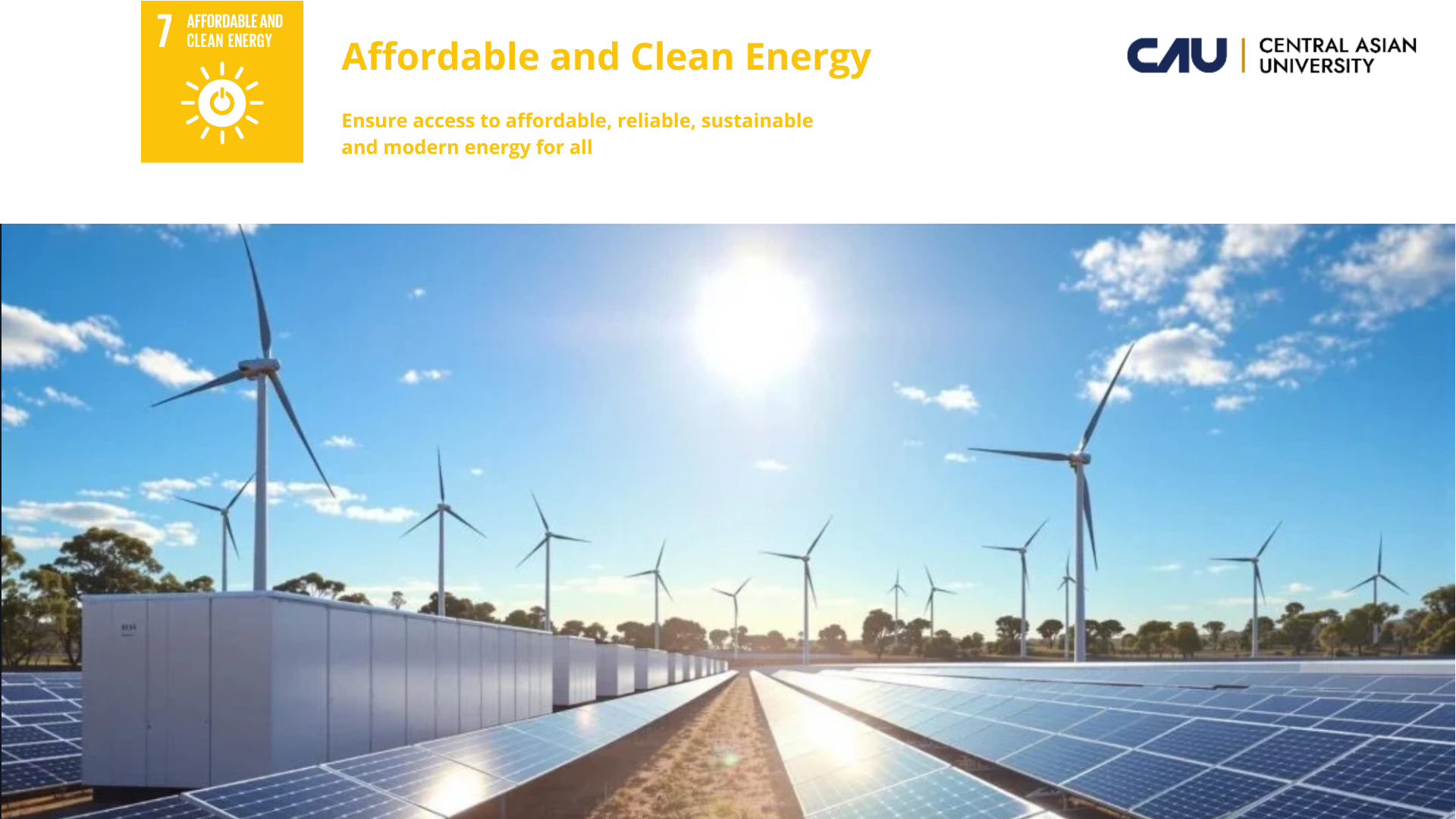
Affordable and Clean Energy - SDG 7
Renewable Energy Integration at Central Asian University
Central Asian University is committed to advancing sustainable energy practices through the active integration of renewable energy technologies across its campus. Recognizing the environmental and economic challenges of conventional electricity, CAU prioritizes clean energy solutions that reduce costs, minimize emissions, and strengthen institutional resilience.
One of the university’s most impactful initiatives is the installation of solar panels on the rooftops of university buildings. These systems provide a reliable and renewable source of electricity year-round, significantly reducing dependence on grid-based power and fossil fuels. As a result, CAU prevents several tons of CO₂ emissions annually and saves operational costs that can be redirected toward academic and research development. The university’s strategic vision aims for 100% renewable energy by 2030, with continuous expansion of its solar infrastructure to support this goal.
Beyond infrastructure, CAU encourages innovation through pilot projects that integrate renewable energy systems into teaching and research. Students and faculty use these projects to explore solar efficiency, energy storage, and smart distribution systems bridging theory and real-world application to prepare graduates for global energy challenges.
Central Asian University is committed to advancing sustainable energy practices through the active integration of renewable energy technologies across its campus. Recognizing the environmental and economic challenges of conventional electricity, CAU prioritizes clean energy solutions that reduce costs, minimize emissions, and strengthen institutional resilience.
One of the university’s most impactful initiatives is the installation of solar panels on the rooftops of university buildings. These systems provide a reliable and renewable source of electricity year-round, significantly reducing dependence on grid-based power and fossil fuels. As a result, CAU prevents several tons of CO₂ emissions annually and saves operational costs that can be redirected toward academic and research development. The university’s strategic vision aims for 100% renewable energy by 2030, with continuous expansion of its solar infrastructure to support this goal.
Beyond infrastructure, CAU encourages innovation through pilot projects that integrate renewable energy systems into teaching and research. Students and faculty use these projects to explore solar efficiency, energy storage, and smart distribution systems bridging theory and real-world application to prepare graduates for global energy challenges.
Wind Energy Integration
To further diversify its renewable energy portfolio, CAU has incorporated wind energy systems into its campus energy strategy. By harnessing local wind conditions through modern turbines, the university generates clean electricity without greenhouse gas emissions or air pollutants. This initiative reduces reliance on fossil fuels, helping CAU avoid tons of CO₂ emissions annually while contributing to improved air quality and freshwater conservation.
Wind energy’s benefits extend beyond environmental impact. The visible presence of turbines on campus symbolizes progress and serves as a daily reminder of the university’s dedication to sustainability. It also promotes awareness and responsibility among students, fostering a strong culture of environmental stewardship within the university community.
Through these integrated renewable energy efforts combining solar and wind systems with education and innovation, Central Asian University sets a regional example of how higher education institutions can lead the transition toward a cleaner, more sustainable future.
To further diversify its renewable energy portfolio, CAU has incorporated wind energy systems into its campus energy strategy. By harnessing local wind conditions through modern turbines, the university generates clean electricity without greenhouse gas emissions or air pollutants. This initiative reduces reliance on fossil fuels, helping CAU avoid tons of CO₂ emissions annually while contributing to improved air quality and freshwater conservation.
Wind energy’s benefits extend beyond environmental impact. The visible presence of turbines on campus symbolizes progress and serves as a daily reminder of the university’s dedication to sustainability. It also promotes awareness and responsibility among students, fostering a strong culture of environmental stewardship within the university community.
Through these integrated renewable energy efforts combining solar and wind systems with education and innovation, Central Asian University sets a regional example of how higher education institutions can lead the transition toward a cleaner, more sustainable future.
Decent Work and Economic Growth - SDG 8
The launch of the CAU Career Center in March 2024 marked a major step in Central Asian University’s mission to link education with employability. Created to bridge the gap between academic learning and the job market, the Center reflects CAU’s commitment to SDG 8: Decent Work and Economic Growth by preparing students for successful, sustainable careers.
The Career Center provides equal access to professional development opportunities, helping students enhance their CVs, prepare for interviews, and build confidence through personalized consultations and mock sessions. It also publishes useful resources and articles about career planning, job search strategies, and labor market trends, ensuring students are ready to meet real-world challenges.
A key highlight was the CAU Job Fair 2025, which connected students with over 90 leading employers, including AKFA Group Companies, Hilton Hotels, IT-Park, Nestlé, Coca-Cola, and Beeline. The event offered students valuable networking opportunities, direct contact with recruiters, and insight into hiring processes.
Since its establishment, the Career Center has supported the successful graduation of 472 students, with 298 (over 60%)now employed in green and sustainability-focused jobs. CAU graduates are making positive contributions in finance, healthcare, education, business, technology, and design demonstrating how the university’s focus on employability and sustainability prepares them to drive future economic growth.
The Career Center provides equal access to professional development opportunities, helping students enhance their CVs, prepare for interviews, and build confidence through personalized consultations and mock sessions. It also publishes useful resources and articles about career planning, job search strategies, and labor market trends, ensuring students are ready to meet real-world challenges.
A key highlight was the CAU Job Fair 2025, which connected students with over 90 leading employers, including AKFA Group Companies, Hilton Hotels, IT-Park, Nestlé, Coca-Cola, and Beeline. The event offered students valuable networking opportunities, direct contact with recruiters, and insight into hiring processes.
Since its establishment, the Career Center has supported the successful graduation of 472 students, with 298 (over 60%)now employed in green and sustainability-focused jobs. CAU graduates are making positive contributions in finance, healthcare, education, business, technology, and design demonstrating how the university’s focus on employability and sustainability prepares them to drive future economic growth.
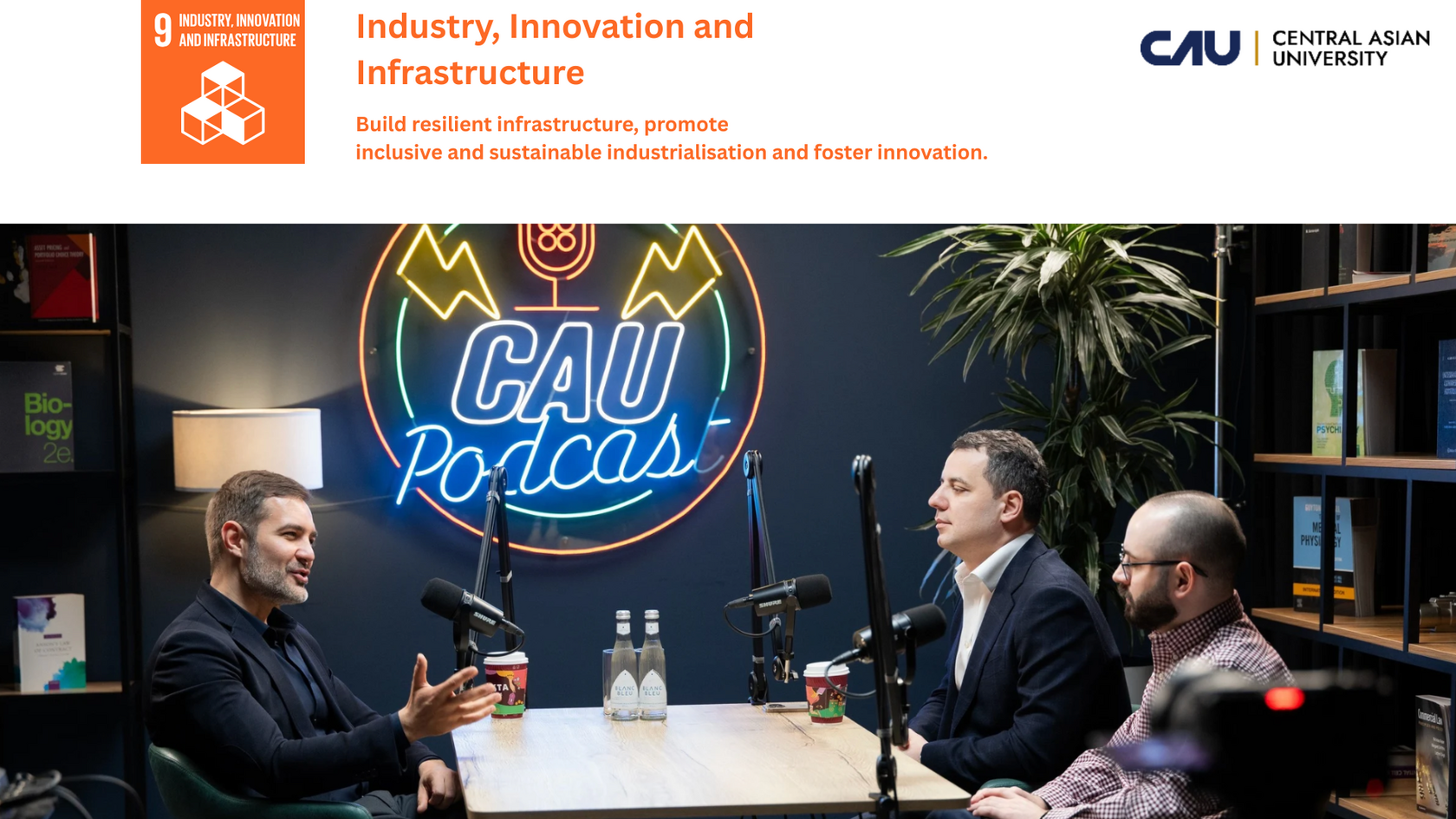
Industry, Innovation, and Infrastructure - SDG 9
Central Asian University is committed to fostering innovation, building resilient infrastructure, and promoting sustainable industrial development in alignment with Sustainable Development Goal 9. The university integrates creativity, science, and technology to meet real-world needs through research, invention, and interdisciplinary collaboration. CAU’s Dental School Dean has significantly advanced medical and dental technology, holding three registered patents, including a UK-registered design for Intra Oral Dental Sensing Equipment (Design No. 6295353). These innovations highlight CAU’s dedication to research excellence and modernization of healthcare technologies.
The university continues to strengthen its reputation as a hub of innovation through impactful research, competitions, and industry collaborations. The Vice-Rector for Research and Innovation leads numerous initiatives empowering students and faculty to develop sustainable solutions in education, healthcare, and technology.
CAU’s state-of-the-art infrastructure from modern laboratories and research hubs to inclusive, eco-friendly campus design supports creativity, experimentation, and collaboration. Every space on campus reflects the university’s dedication to accessible, sustainable, and innovation-driven learning.
The Artificial Intelligence Lab stands as a beacon of smart innovation, developing AI-powered tools in education, medicine, and business. Its projects include adaptive learning platforms for over 250 students, AI-driven medical applications for 1,000+ users, and intelligent hiring systems optimizing HR processes.
CAU Diagnostics further advances healthcare innovation by integrating cutting-edge technologies such as Roche, Sysmex, and Shimadzu for precision diagnostics and pharmaceutical quality control. Its upcoming national expansion - 12 laboratories and 200 blood collection points aims to create an accessible healthcare network across Uzbekistan.
In the field of finance, the CAU Bloomberg Finance Lab bridges academic learning and real-world finance through access to global market data, research tools, and professional certification opportunities. It serves as a regional center of excellence, driving innovation in financial education and economic growth. CAU also gained international recognition when an Engineering School researcher presented joint work with the University of Cambridge at the IEEE International Conference on Robotics and Automation (ICRA). The study introduced a groundbreaking robotic learning framework, underscoring CAU’s global presence in advanced technology and AI research.
The university continues to strengthen its reputation as a hub of innovation through impactful research, competitions, and industry collaborations. The Vice-Rector for Research and Innovation leads numerous initiatives empowering students and faculty to develop sustainable solutions in education, healthcare, and technology.
CAU’s state-of-the-art infrastructure from modern laboratories and research hubs to inclusive, eco-friendly campus design supports creativity, experimentation, and collaboration. Every space on campus reflects the university’s dedication to accessible, sustainable, and innovation-driven learning.
The Artificial Intelligence Lab stands as a beacon of smart innovation, developing AI-powered tools in education, medicine, and business. Its projects include adaptive learning platforms for over 250 students, AI-driven medical applications for 1,000+ users, and intelligent hiring systems optimizing HR processes.
CAU Diagnostics further advances healthcare innovation by integrating cutting-edge technologies such as Roche, Sysmex, and Shimadzu for precision diagnostics and pharmaceutical quality control. Its upcoming national expansion - 12 laboratories and 200 blood collection points aims to create an accessible healthcare network across Uzbekistan.
In the field of finance, the CAU Bloomberg Finance Lab bridges academic learning and real-world finance through access to global market data, research tools, and professional certification opportunities. It serves as a regional center of excellence, driving innovation in financial education and economic growth. CAU also gained international recognition when an Engineering School researcher presented joint work with the University of Cambridge at the IEEE International Conference on Robotics and Automation (ICRA). The study introduced a groundbreaking robotic learning framework, underscoring CAU’s global presence in advanced technology and AI research.
Reduced Inequalities - SDG 10
At Central Asian University, inclusivity and equal access to education are core values. The university believes that diversity enriches learning and that every student, regardless of background or ability, deserves the opportunity to thrive academically and socially. Through inclusive infrastructure, assistive technologies, and strong student support, CAU demonstrates its commitment to reducing inequalities and fostering an accessible academic environment.
Inclusive Infrastructure and Design
CAU’s campus is built for universal accessibility, featuring tactile ground tiles, braille-marked elevators, wide corridors, and wheelchair-friendly ramps. Each building includes accessible toilets and designated parking areas, ensuring independence and dignity for all members of the community.
CAU’s campus is built for universal accessibility, featuring tactile ground tiles, braille-marked elevators, wide corridors, and wheelchair-friendly ramps. Each building includes accessible toilets and designated parking areas, ensuring independence and dignity for all members of the community.
Assistive Technology and Learning Support
To make learning accessible for everyone, CAU integrates assistive tools such as Braille keyboards, adjustable workstations, and digital learning resources. The university library provides Braille books and materials tailored to diverse physical and cognitive needs, empowering all students to fully engage in their studies.
To make learning accessible for everyone, CAU integrates assistive tools such as Braille keyboards, adjustable workstations, and digital learning resources. The university library provides Braille books and materials tailored to diverse physical and cognitive needs, empowering all students to fully engage in their studies.
Inclusive Pedagogy and Academic Support
Faculty members are trained in inclusive teaching practices, offering flexible assessments and personalized feedback. The Student Wellbeing Department collaborates with instructors to design individualized learning plans that help students with disabilities overcome challenges and reach their full potential.
Faculty members are trained in inclusive teaching practices, offering flexible assessments and personalized feedback. The Student Wellbeing Department collaborates with instructors to design individualized learning plans that help students with disabilities overcome challenges and reach their full potential.
Mental Health and Wellbeing Services
Recognizing the link between emotional health and academic success, CAU provides professional counseling, group therapy, and wellness workshops. These initiatives promote empathy and awareness, fostering a campus culture that values mental health and emotional resilience.
Recognizing the link between emotional health and academic success, CAU provides professional counseling, group therapy, and wellness workshops. These initiatives promote empathy and awareness, fostering a campus culture that values mental health and emotional resilience.
Awareness and Community Engagement
University-wide campaigns, seminars, and student-led events raise awareness of disability rights and social inclusion. These initiatives encourage understanding, respect, and collaboration across the university community.
Through these ongoing efforts, Central Asian University actively advances Sustainable Development Goal 10: Reduced Inequalities. By ensuring full accessibility, promoting inclusive education, and nurturing a culture of respect, CAU sets a national example of how education can unite people through equality, empathy, and shared opportunity.
University-wide campaigns, seminars, and student-led events raise awareness of disability rights and social inclusion. These initiatives encourage understanding, respect, and collaboration across the university community.
Through these ongoing efforts, Central Asian University actively advances Sustainable Development Goal 10: Reduced Inequalities. By ensuring full accessibility, promoting inclusive education, and nurturing a culture of respect, CAU sets a national example of how education can unite people through equality, empathy, and shared opportunity.
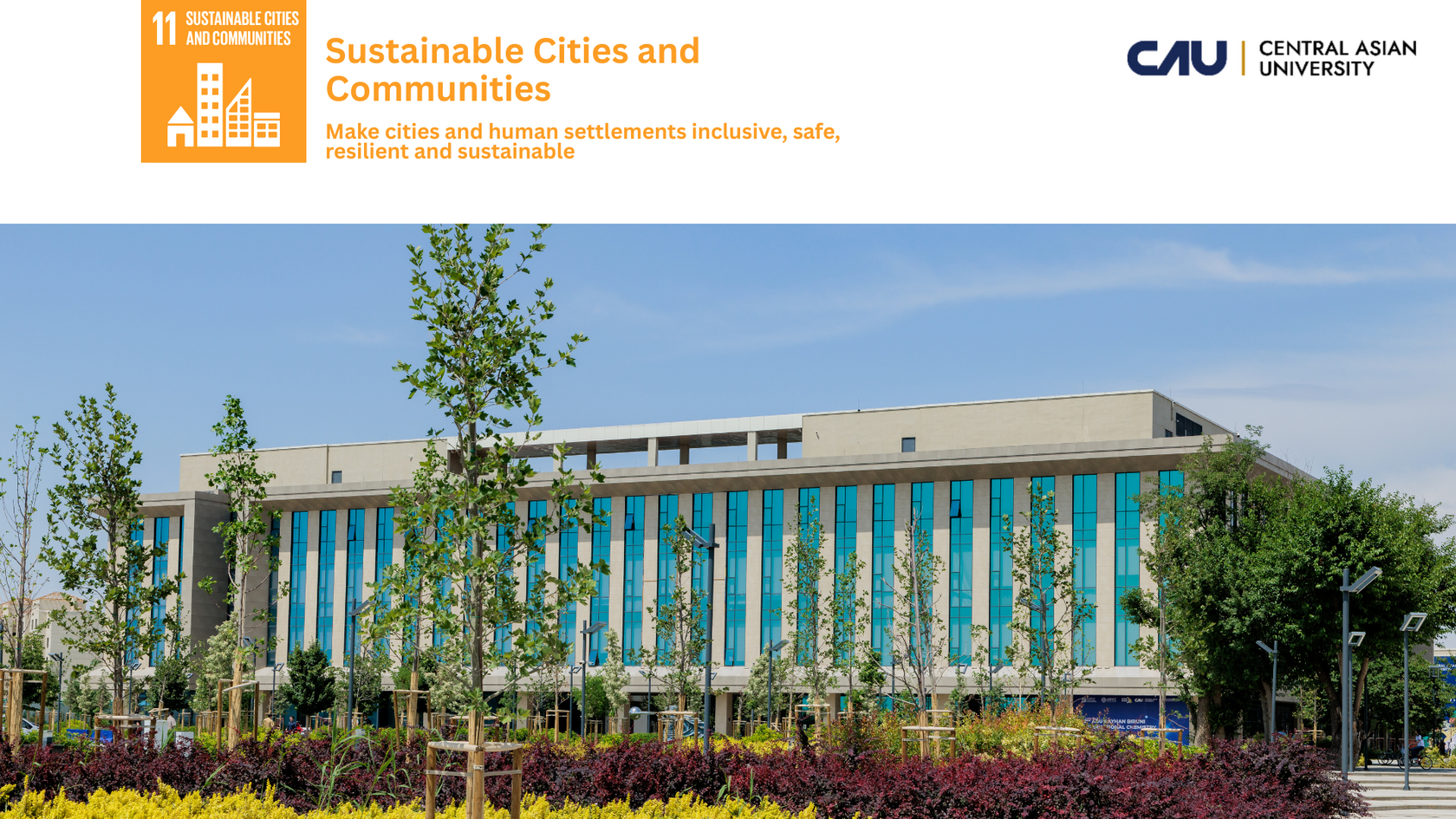
Sustainable Cities and Communities - SDG 11
Central Asian University promotes sustainability, accessibility, and safety through a comprehensive transportation and mobility strategy. The university reduces private vehicle use by offering free shuttle buses from the metro and using electric golf cars for internal transport, cutting carbon emissions and easing campus congestion.
Pedestrian-friendly infrastructure includes marked pathways, traffic calming measures, solar-powered street lamps, and accessibility features like ramps and tactile guides to support all community members. CAU runs awareness campaigns encouraging sustainable transport habits, aiming to reduce private vehicle dependency by 50% and fully transition internal transport to electric vehicles by 2030.
In education, CAU’s Department of Architecture and Design trains students in sustainable, resilient urban planning and construction, supporting Uzbekistan’s development goals. Student exhibitions showcase innovative, sustainable projects. Sustainability is further embedded through community engagement, with student clubs organizing recycling and clean-up events, and staff trained in sustainable procurement to reinforce responsible resource use.
Pedestrian-friendly infrastructure includes marked pathways, traffic calming measures, solar-powered street lamps, and accessibility features like ramps and tactile guides to support all community members. CAU runs awareness campaigns encouraging sustainable transport habits, aiming to reduce private vehicle dependency by 50% and fully transition internal transport to electric vehicles by 2030.
In education, CAU’s Department of Architecture and Design trains students in sustainable, resilient urban planning and construction, supporting Uzbekistan’s development goals. Student exhibitions showcase innovative, sustainable projects. Sustainability is further embedded through community engagement, with student clubs organizing recycling and clean-up events, and staff trained in sustainable procurement to reinforce responsible resource use.
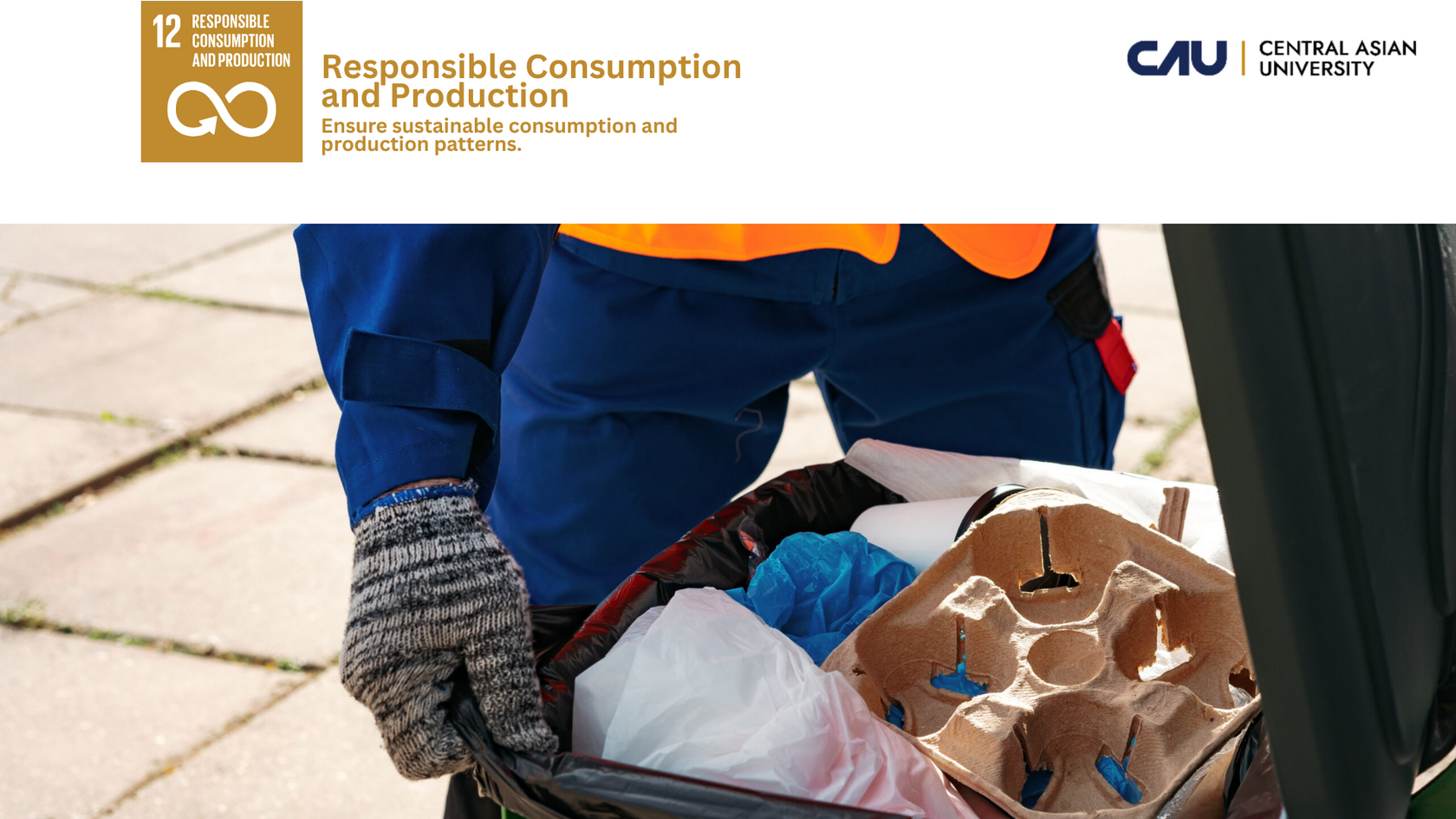
Responsible Consumption and Production - SDG 12
Central Asian University strengthened its commitment to sustainable waste management by adopting a comprehensive framework based on the 3R principles: Reduce, Reuse, and Recycle.
Looking ahead, CAU plans to integrate AI monitoring for waste management optimization and explore waste-to-energy projects. The university aims for a 50% reduction in total waste and a 70% recycling rate by 2030, reinforcing its dedication to sustainability in campus operations.
- Reduce: CAU eliminated paper use by digitizing administrative processes and banned single-use plastics on campus, encouraging reusable containers supported by filtered water stations on every floor.
- Reuse: The university promotes eco-friendly mobility with free bicycles and electric scooters for short-distance travel and advances digital submissions to reduce printing.
- Recycle: CAU implemented a color-coded bin system for waste segregation and partnered with local organizations for efficient recycling and composting organic waste into fertilizer distributed to local farmers, supporting a circular economy.
Looking ahead, CAU plans to integrate AI monitoring for waste management optimization and explore waste-to-energy projects. The university aims for a 50% reduction in total waste and a 70% recycling rate by 2030, reinforcing its dedication to sustainability in campus operations.
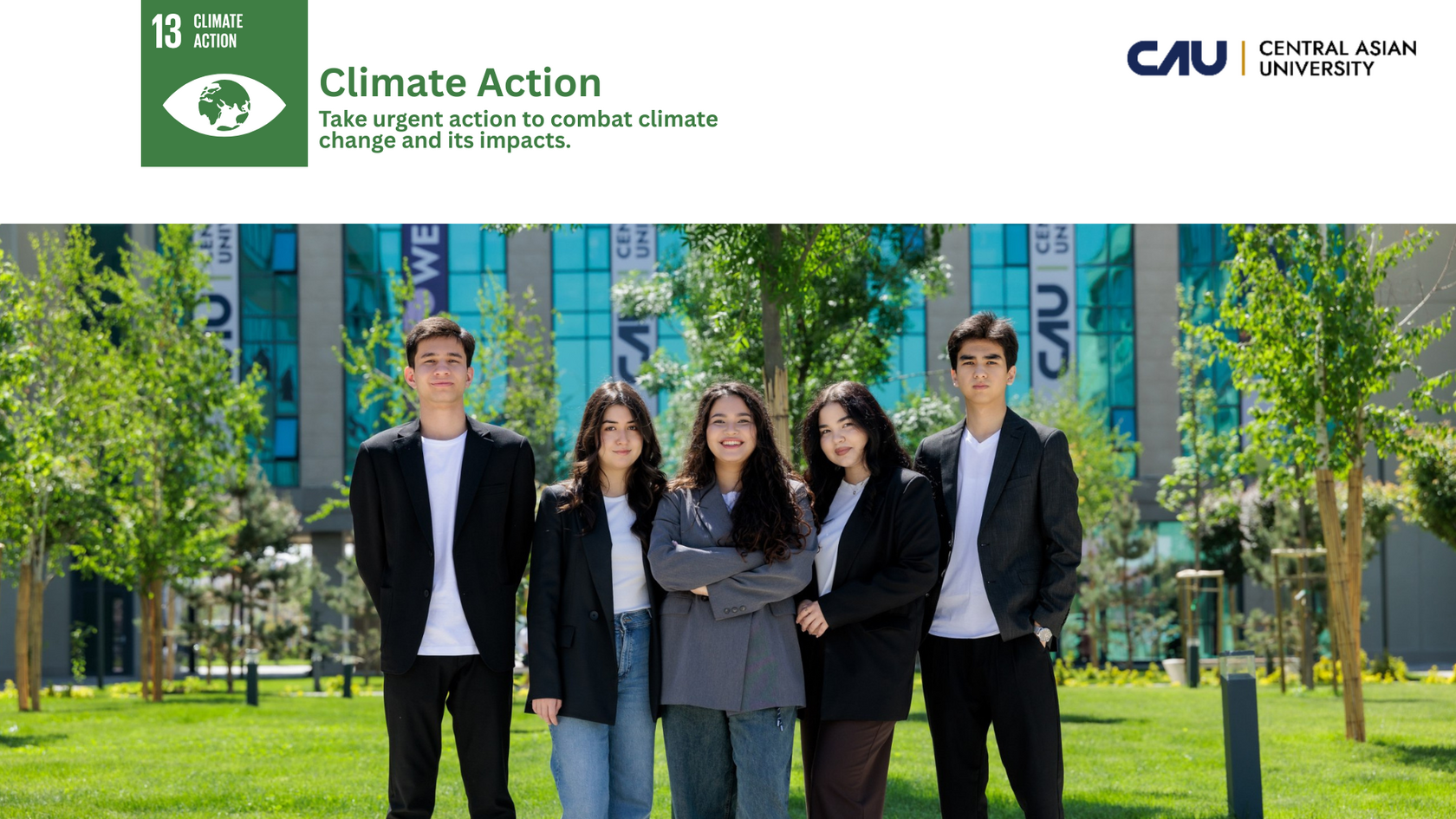
Climate Action - SDG 13
Central Asian University is committed to combating climate change by integrating sustainability into all campus operations, research, and education. The university aims to achieve carbon neutrality by 2050, with a 50% reduction in greenhouse gas emissions (Scope 1 & 2) by 2035. Key strategies include:
CAU monitors its carbon footprint using internationally recognized standards (GHG Protocol) and reports emissions transparently. Initiatives like AI-driven energy management and behavioral awareness programs support continuous improvement. By fostering innovation, responsible operations, and community engagement, CAU positions itself as a regional leader in climate action, advancing resilience and sustainability in Central Asia.
- Expanding renewable energy use, especially solar power installations planned by 2026
- Improving energy efficiency through building renovations
- Electrifying the university vehicle fleet
- Promoting sustainable behaviors and green policies campus-wide
CAU monitors its carbon footprint using internationally recognized standards (GHG Protocol) and reports emissions transparently. Initiatives like AI-driven energy management and behavioral awareness programs support continuous improvement. By fostering innovation, responsible operations, and community engagement, CAU positions itself as a regional leader in climate action, advancing resilience and sustainability in Central Asia.
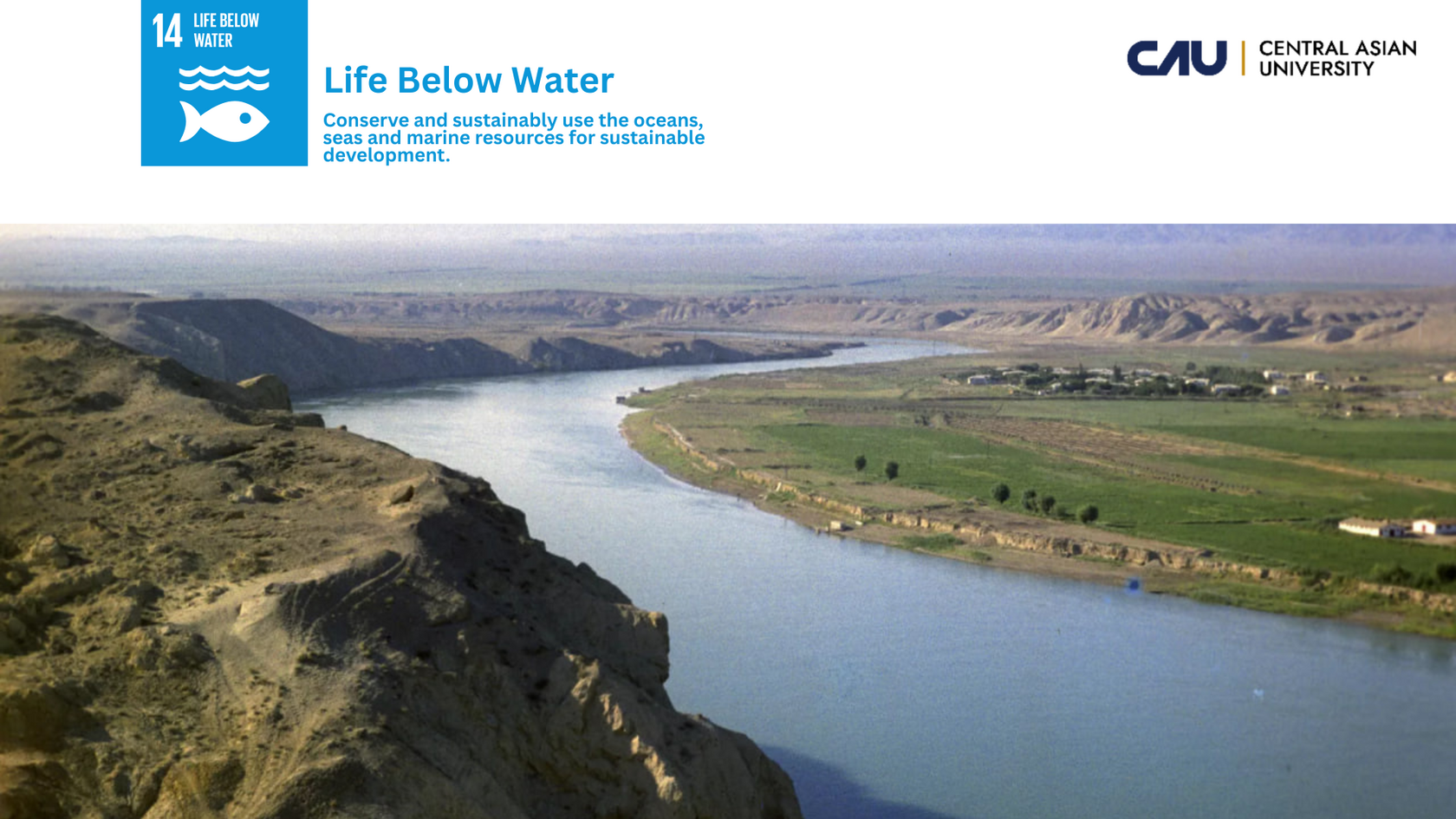
Life Below Water - SDG 14
Central Asian University actively addresses water ecosystem preservation and sustainable resource use despite Uzbekistan being landlocked. The university focuses on challenges related to the Aral Sea ecological crisis through research, education, and community engagement.
Key initiatives include:
These efforts demonstrate CAU’s commitment to SDG 14 by promoting sustainable aquatic ecosystems, supporting affected communities, and integrating environmental awareness into professional education.
Key initiatives include:
- Groundbreaking research by Dr. Gulnoza Usmonova on sustainable fishery practices and community development in the Aral Sea region, published in a leading marine science journal.
- An educational field visit to Muynak by CAU’s School of Medicine, linking environmental sustainability with public health through workshops and collaboration with local healthcare providers.
These efforts demonstrate CAU’s commitment to SDG 14 by promoting sustainable aquatic ecosystems, supporting affected communities, and integrating environmental awareness into professional education.
Life on Land - SDG 15
Central Asian University actively promotes the protection and sustainable management of terrestrial ecosystems in line with SDG 15. Key initiatives include:
Through practical action, education, and community engagement, CAU strengthens ecological awareness and contributes to biodiversity conservation and sustainable land use for future generations.
- Participation in the national “Yashil Makon” project, with students and staff planting trees to combat desertification, enhance carbon sequestration, and improve urban environments.
- Organizing eco-clean-up campaigns, collecting over 150 bags of waste to foster environmental responsibility and maintain healthy ecosystems.
- Hosting expert lectures, such as by Dr. Alireza Mokhtar, on climate science and sustainable land management, linking global environmental challenges to regional biodiversity and ecosystem resilience.
Through practical action, education, and community engagement, CAU strengthens ecological awareness and contributes to biodiversity conservation and sustainable land use for future generations.
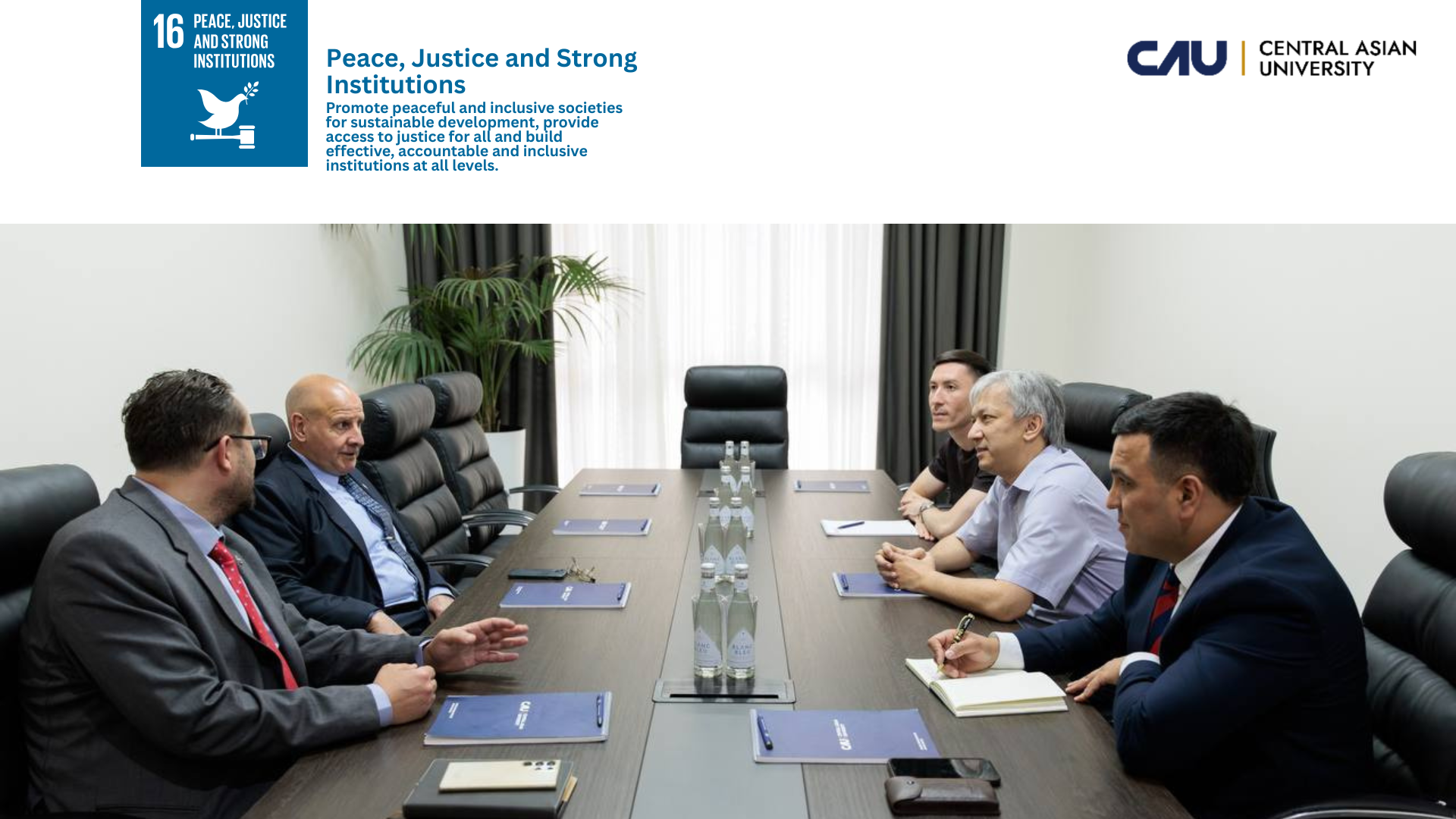
Peace, Justice, and Strong Institutions - SDG 16
Central Asian University is dedicated to cultivating responsible leaders who contribute to peaceful, just, and inclusive societies. Key initiatives include: