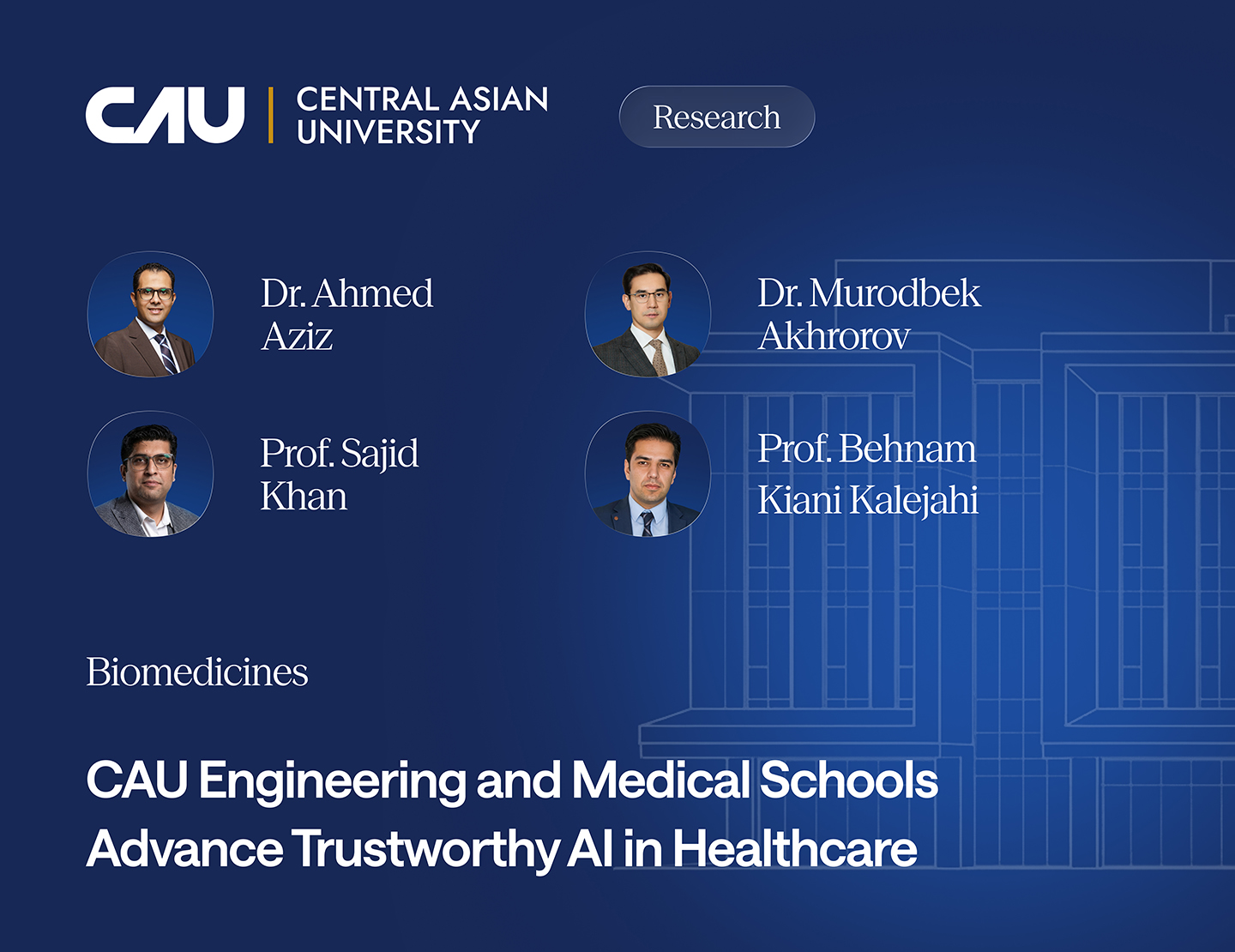
The Engineering School and the Medical School of Central Asian University have published a collaborative research study in the international peer-reviewed journal Biomedicines, highlighting the University's commitment to interdisciplinary research at the intersection of engineering, artificial intelligence, and clinical medicine.
The study, "Uncertainty-Aware Prediction Across Endoscopic Domains: Laryngeal Narrow-Band and Gastrointestinal Imaging," was conducted by Dr. Ahmed Aziz, Prof. Behnam Kiani Kalejahi, Prof. Sajid Khan from the Engineering School, in collaboration with Dr. Murodbek Akhrorov from the Medical School.
The research investigates the reliability of artificial intelligence models for endoscopic image analysis under real-world clinical conditions. The findings demonstrate that conventional evaluation methods may overestimate AI performance, while uncertainty-aware approaches improve the reliability of automated predictions by identifying cases that require expert clinical review. The study also highlights the importance of robust model validation, calibration, and cross-domain transfer learning in the development of trustworthy AI systems for healthcare.
Published in Biomedicines, the research contributes to ongoing international efforts to develop safe, transparent, and clinically reliable artificial intelligence for medical imaging. To promote transparency and reproducibility, the authors have made the study's code, experimental protocols, and evaluation framework publicly available.
This publication reflects Central Asian University's strategic emphasis on interdisciplinary research, fostering collaboration between engineering and medicine to advance innovative technologies with meaningful impact on healthcare and patient outcomes.