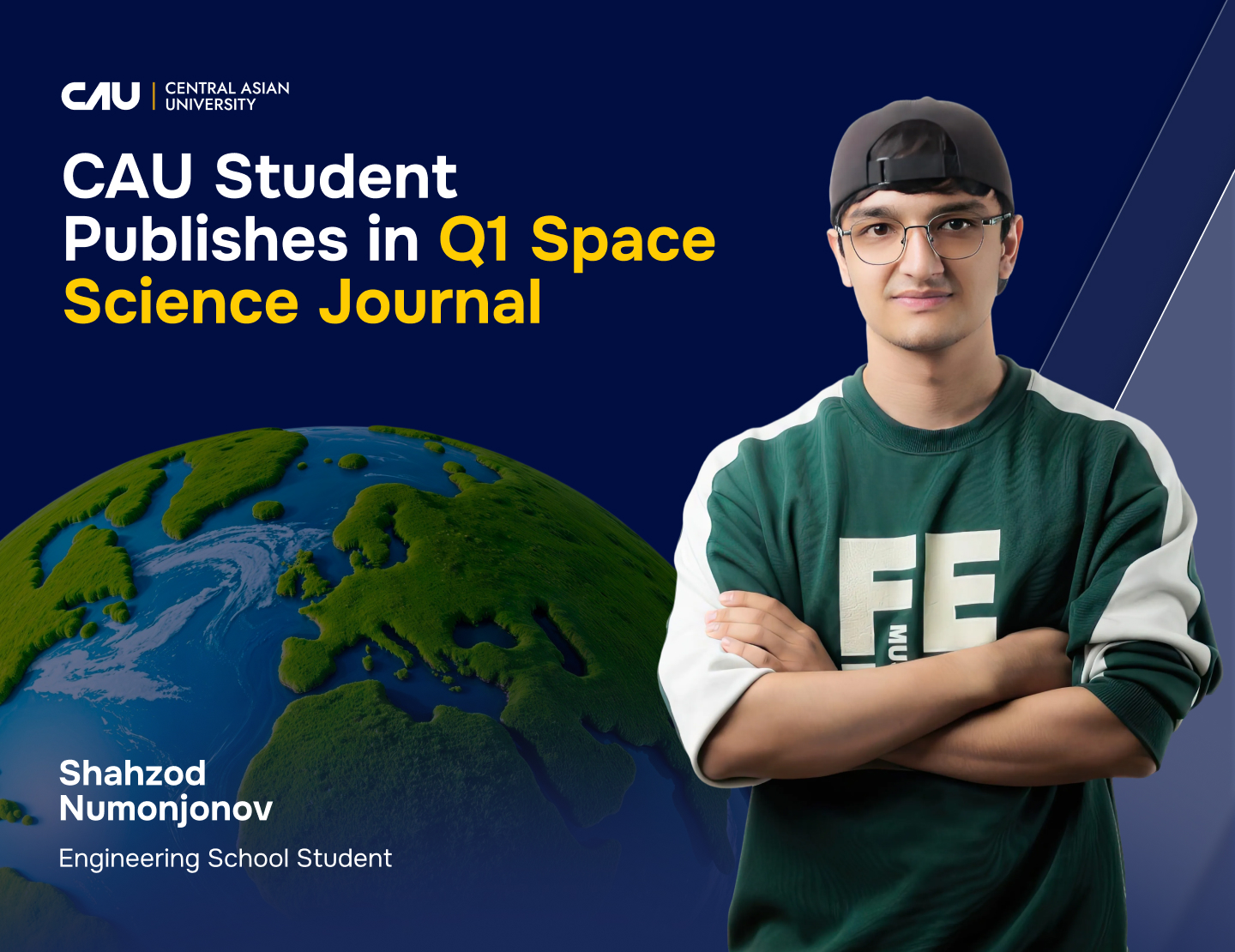
CAU is delighted to spotlight another milestone in student research excellence. This month, our Computer Science student from the School of Engineering, Shahzod Numonjonov, has contributed as a co-author to a peer-reviewed article published in Planetary and Space Science (Elsevier) — a prestigious Q1 journal recognized in both Scopus and Web of Science. This accomplishment highlights not only the student’s dedication to scientific inquiry, but also the expanding research presence of CAU on the global academic stage.
The article, titled “Pre-seismic ionospheric disturbances following the 2025 7.7 Mandalay, Burma (Myanmar) Earthquake from GNSS observations,” explores how the Earth’s upper atmosphere can offer clues about major seismic events. By analyzing Total Electron Content (TEC) variations captured through GNSS monitoring stations in Thailand, the research team identified notable ionospheric anomalies that appeared prior to the devastating 2025 Mw 7.7 Mandalay earthquake. These findings contribute to a rapidly developing field that seeks to refine early-warning systems and deepen scientific understanding of earthquake-related atmospheric processes.
Shahzod played a key role in advancing the study. His technical responsibilities included the preprocessing and cleaning of extensive TEC datasets, implementing data-science–driven time-series analysis, and detecting significant patterns in ionospheric behavior. He also assisted in interpreting the results and preparing visual materials that supported the team’s overall conclusions. His contributions exemplify the strong integration of computer science, geophysics, and data analytics within modern interdisciplinary research.
This achievement reflects the growing research culture at CAU, where students are encouraged to challenge themselves, collaborate internationally, and participate in impactful scientific work. The success of this publication serves as an inspiration to fellow students and underscores the importance of nurturing young scholars who are ready to contribute to global scientific progress.