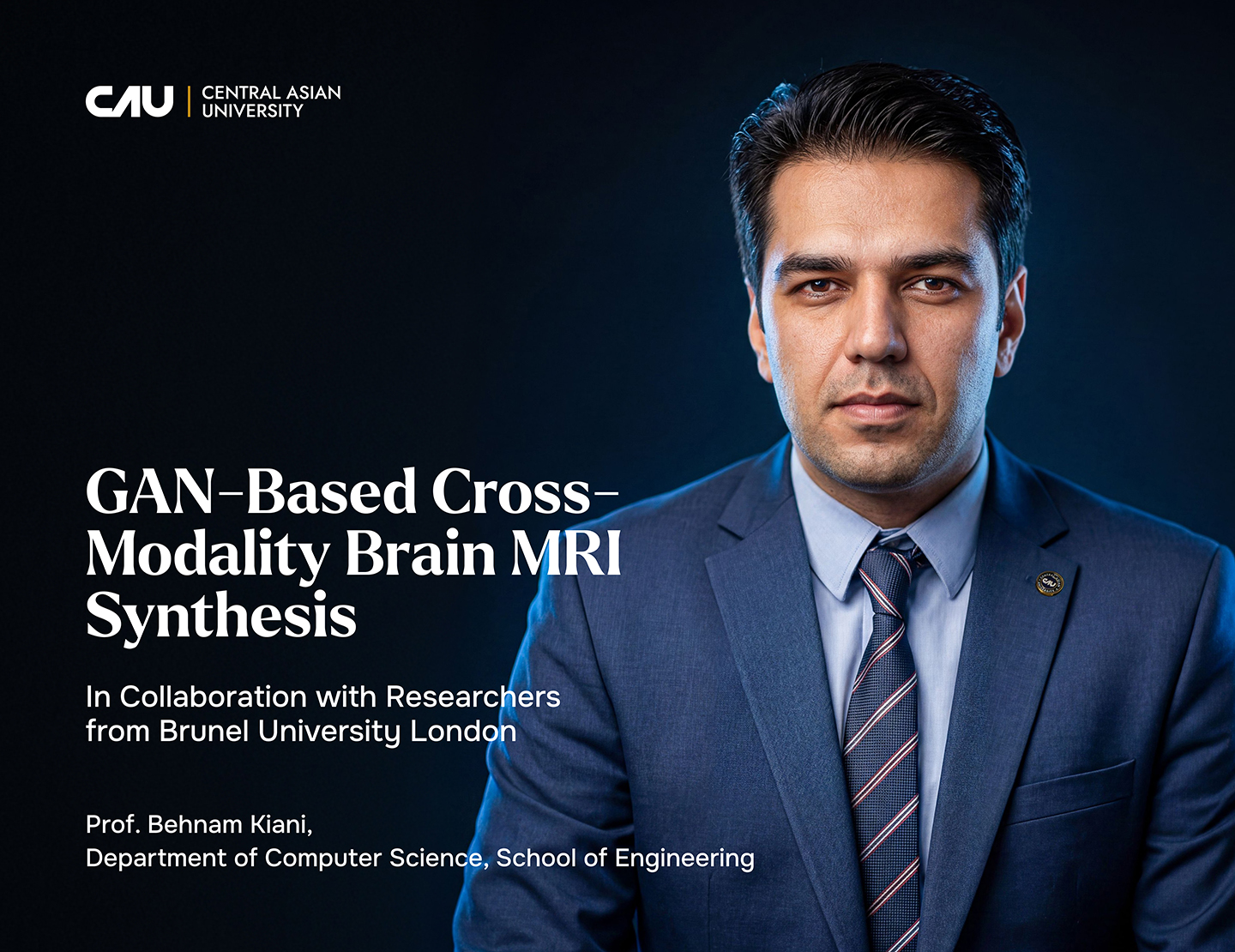
The research article “GAN-Based Cross-Modality Brain MRI Synthesis” has been published in Biomimetics (JCR Q1 – Biomedical Engineering, Multidisciplinary). The study was conducted through an international collaboration between Prof. Behnam Kiani of Central Asian University and researchers from Brunel University London, highlighting a strong academic partnership in artificial intelligence and medical imaging.
The article presents a deep learning framework based on Generative Adversarial Networks (GANs) to synthesize one magnetic resonance imaging (MRI) modality from another. The proposed approach addresses a common clinical challenge, missing or incomplete MRI sequences, which can limit comprehensive diagnostic evaluation.
By learning the mapping between different MRI contrasts, the model generates high-fidelity synthetic images that closely approximate the target modality. This enables reconstruction of absent imaging data without requiring additional patient scanning.
The framework demonstrates strong potential to reduce scanning time, improve access to complete multimodal imaging datasets, and enhance diagnostic accuracy as well as downstream neuroimaging analysis workflows.
Link
The article presents a deep learning framework based on Generative Adversarial Networks (GANs) to synthesize one magnetic resonance imaging (MRI) modality from another. The proposed approach addresses a common clinical challenge, missing or incomplete MRI sequences, which can limit comprehensive diagnostic evaluation.
By learning the mapping between different MRI contrasts, the model generates high-fidelity synthetic images that closely approximate the target modality. This enables reconstruction of absent imaging data without requiring additional patient scanning.
The framework demonstrates strong potential to reduce scanning time, improve access to complete multimodal imaging datasets, and enhance diagnostic accuracy as well as downstream neuroimaging analysis workflows.
Link