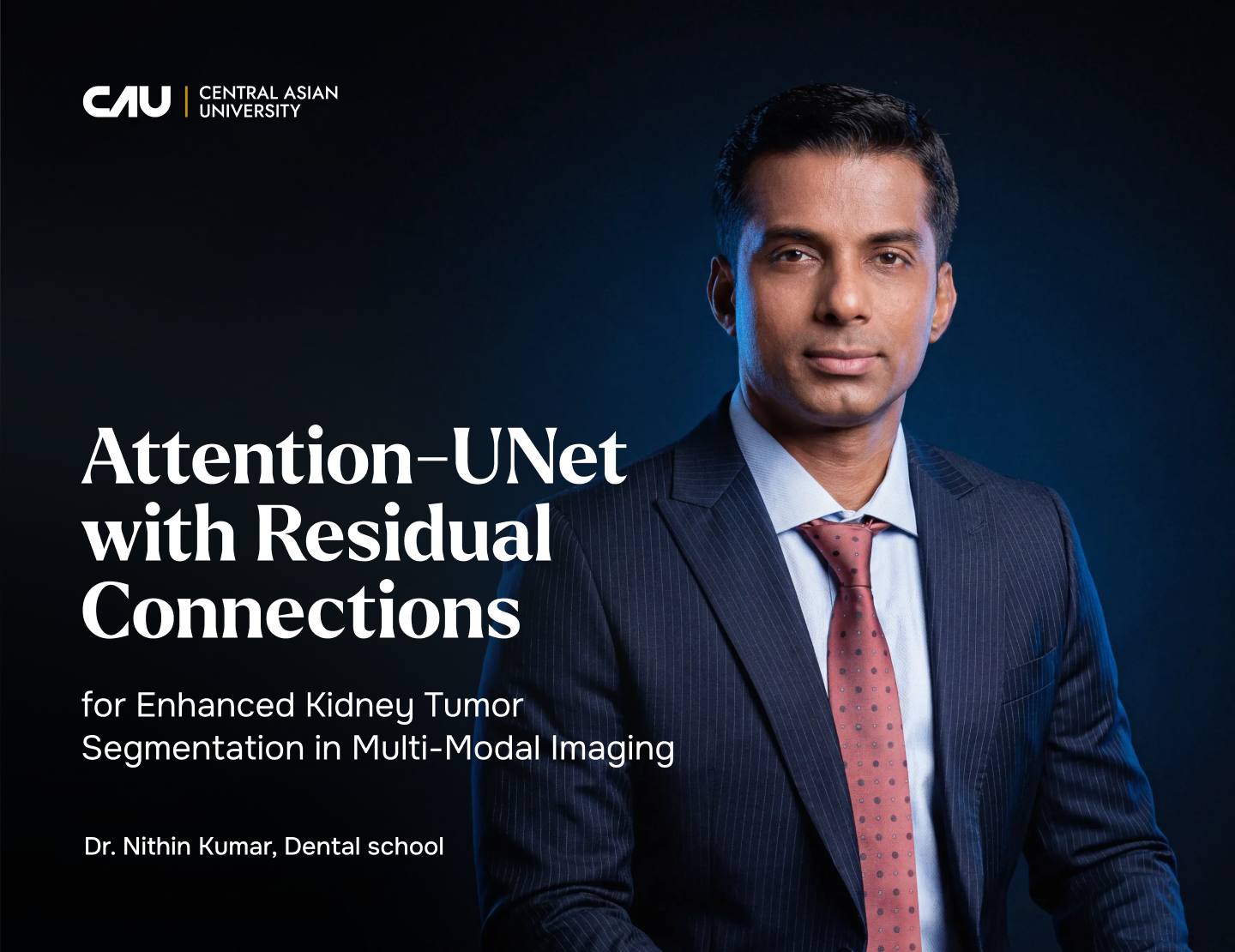
Dr. Nithin Kumar from the Dental School has co-authored a Scopus-indexed research article titled “Attention-UNet with Residual Connections for Enhanced Kidney Tumor Segmentation in Multi-Modal Imaging.” The study presents an advanced deep learning approach for improving kidney tumor segmentation in medical imaging.
Accurate tumor segmentation remains a significant challenge due to the complexity of anatomical structures, variability in tumor morphology, and noise across different imaging modalities. To address these issues, the research team developed an enhanced model based on Attention-UNet architecture with residual connections.
The proposed framework integrates two key components:
Residual Connections, which improve feature propagation and gradient flow, enabling more stable and effective model training.
Attention Gates, which allow the network to focus on clinically relevant regions, improving tumor detection and localization accuracy.
The model combines multi-modal imaging data, including CT and MRI scans, and was trained and validated on publicly available datasets such as KiTS and BraTS. Experimental results demonstrate improved performance in kidney tumor segmentation compared to baseline approaches.
The study contributes to ongoing advancements in AI-driven medical imaging and supports the development of more precise diagnostic tools in oncology.
The publication is available via IEEE Xplore Digital Library.
Accurate tumor segmentation remains a significant challenge due to the complexity of anatomical structures, variability in tumor morphology, and noise across different imaging modalities. To address these issues, the research team developed an enhanced model based on Attention-UNet architecture with residual connections.
The proposed framework integrates two key components:
Residual Connections, which improve feature propagation and gradient flow, enabling more stable and effective model training.
Attention Gates, which allow the network to focus on clinically relevant regions, improving tumor detection and localization accuracy.
The model combines multi-modal imaging data, including CT and MRI scans, and was trained and validated on publicly available datasets such as KiTS and BraTS. Experimental results demonstrate improved performance in kidney tumor segmentation compared to baseline approaches.
The study contributes to ongoing advancements in AI-driven medical imaging and supports the development of more precise diagnostic tools in oncology.
The publication is available via IEEE Xplore Digital Library.