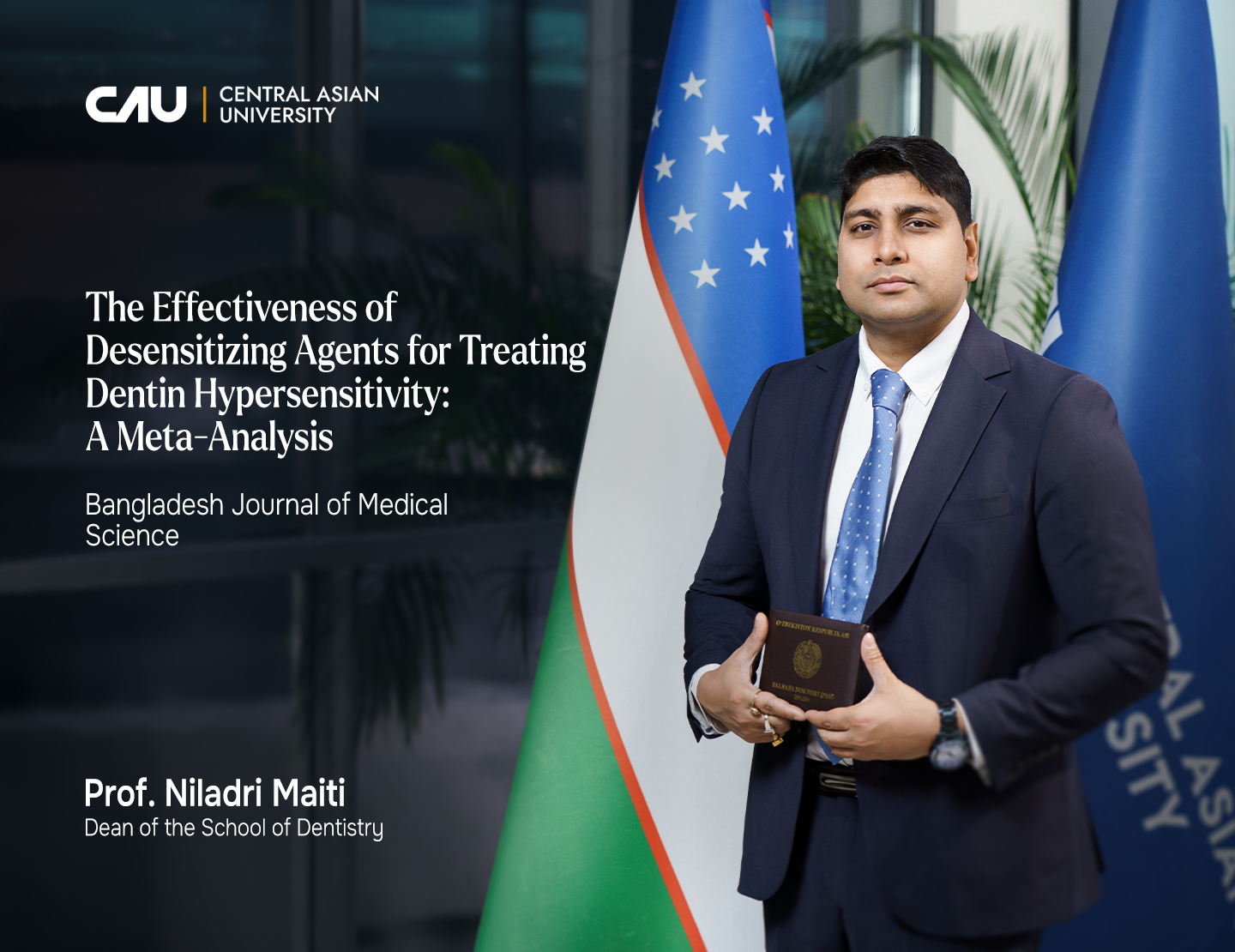
Central Asian University announces the publication of a research article co-authored by Professor Niladri Maiti from the School of Dentistry titled “The Effectiveness of Desensitizing Agents for Treating Dentin Hypersensitivity: A Meta-Analysis.”
The article has been published in the peer-reviewed journal Bangladesh Journal of Medical Science.
The study presents a meta-analysis of 30 randomized controlled trials assessing the effectiveness of different desensitizing agents used in the treatment of dentin hypersensitivity. Data were obtained from PubMed, Embase, and Cochrane databases.
The results indicate that bioactive materials, including bioactive glass, provide the most consistent pain reduction. Arginine-based agents also demonstrated favorable outcomes. Treatment approaches such as laser therapy and silver diamine fluoride (SDF) showed rapid symptom relief, though their use may be limited by cost considerations or potential side effects. At-home treatments, including products containing stannous fluoride, were associated with moderate but accessible clinical benefits.
The comparative analysis of these treatment options supports evidence-based and individualized treatment selection for patients with dentin hypersensitivity.
The article has been published in the peer-reviewed journal Bangladesh Journal of Medical Science.
The study presents a meta-analysis of 30 randomized controlled trials assessing the effectiveness of different desensitizing agents used in the treatment of dentin hypersensitivity. Data were obtained from PubMed, Embase, and Cochrane databases.
The results indicate that bioactive materials, including bioactive glass, provide the most consistent pain reduction. Arginine-based agents also demonstrated favorable outcomes. Treatment approaches such as laser therapy and silver diamine fluoride (SDF) showed rapid symptom relief, though their use may be limited by cost considerations or potential side effects. At-home treatments, including products containing stannous fluoride, were associated with moderate but accessible clinical benefits.
The comparative analysis of these treatment options supports evidence-based and individualized treatment selection for patients with dentin hypersensitivity.