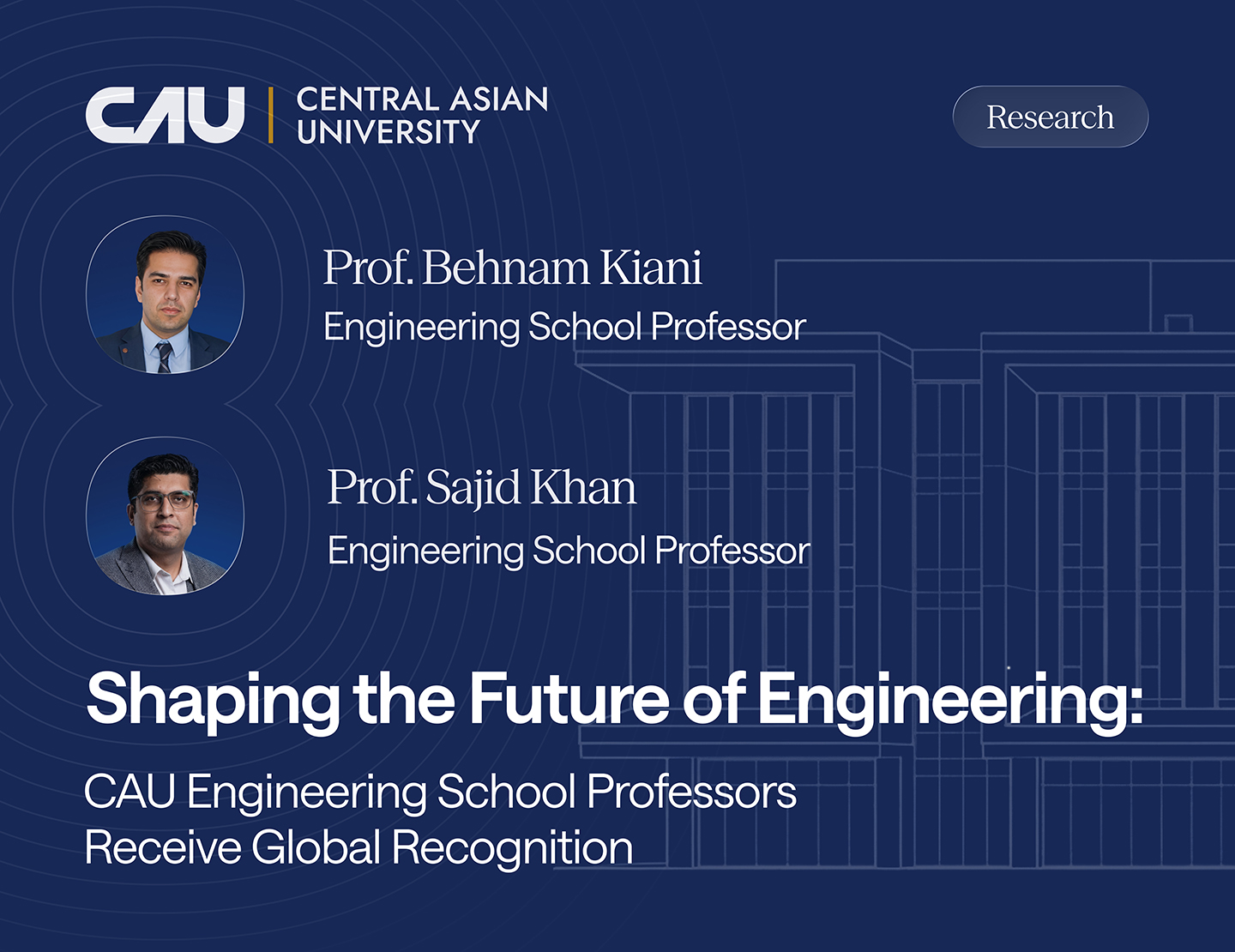
Professors Behnam Kiani Kalejahi and Sajid Khan from the Engineering School of Central Asian University have been awarded the “Best Presented Paper” at the IEMTRONICS 2026 International Conference on IoT, Electronics and Mechatronics, held at Imperial College London, UK. Their work was also selected as a Best Conference Paper candidate, highlighting its significance among the presented research.
Their research, titled “Hybrid GAN-Diffusion and Transformer Models for Cross-Organ Medical Image Synthesis,” introduces a novel framework — GDTNet — aimed at advancing medical image generation across multiple organ domains. Unlike many existing methods that are limited to single-organ applications and require heavy computational resources, GDTNet integrates generative adversarial networks (GAN), diffusion models, and transformer-based attention into a unified, efficient architecture.
A key innovation of the model is the Adaptive Diffusion Residual Bridging (ADRB) mechanism, which dynamically incorporates diffusion features into the adversarial pipeline, improving training stability and enhancing the structural realism of synthesized images.
The framework was evaluated on four widely used open-source datasets: BraTS (brain MRI), LiTS (liver CT), NIH ChestXray14 (chest X-ray), and ACDC (cardiac MRI). GDTNet achieved strong performance, with high-quality metrics (SSIM = 0.89, Dice = 0.91, PSNR = 27 dB), while reducing training time by 40–60% compared to conventional diffusion-based models. In addition, professional radiologists rated the generated images as highly realistic for diagnostic purposes, with an average score of 4.6 out of 5 and strong inter-rater agreement (κ = 0.83).
This achievement highlights the contribution of Central Asian University’s Engineering School to cutting-edge research in artificial intelligence and healthcare technologies, offering practical solutions for medical image reconstruction, diagnostics, and data augmentation.
More information: https://iemtronics.org/