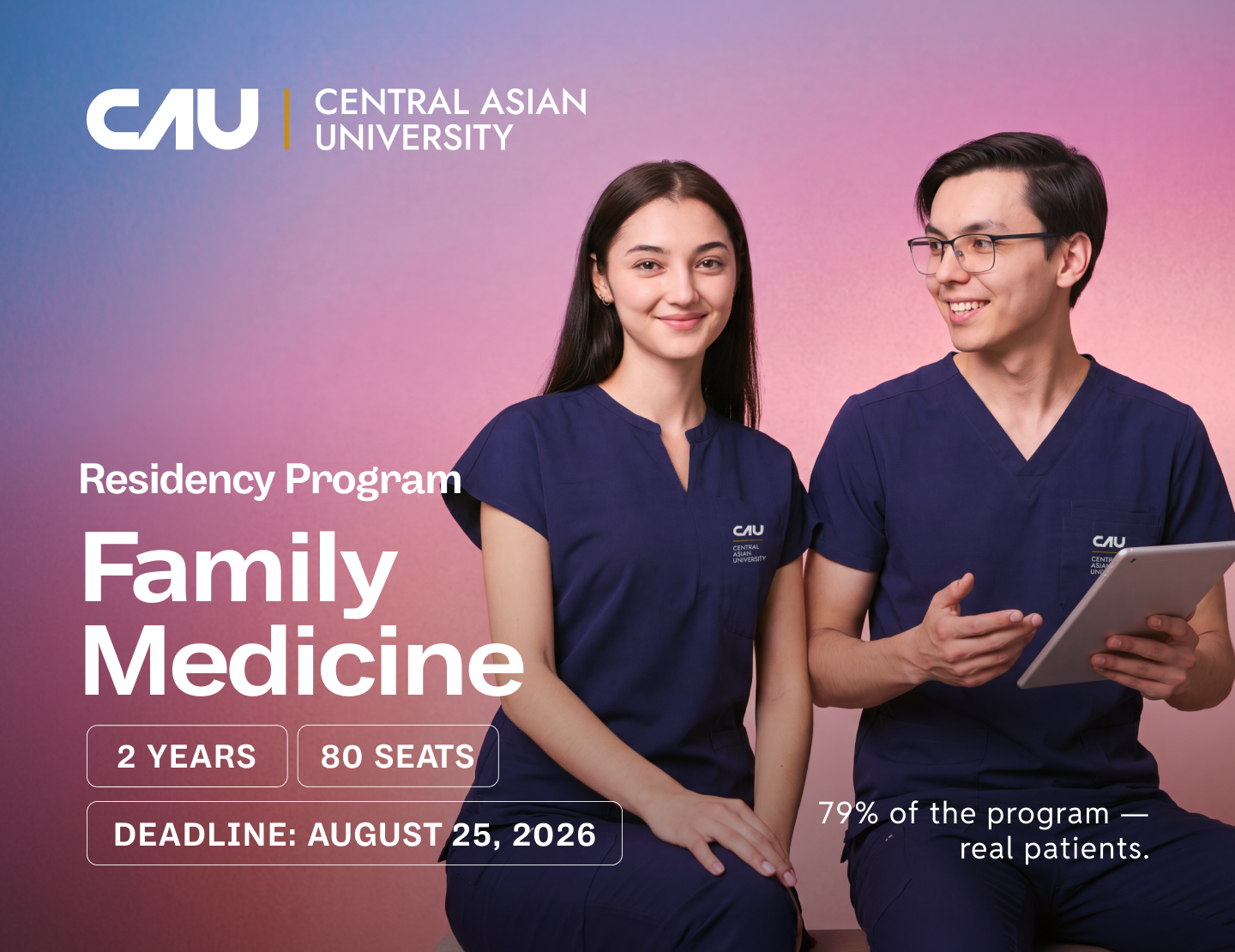
Central Asian University, in partnership with AKFA Medline University Hospital and Social by AKFA, has opened admissions for a two-year Family Medicine Residency Program. Designed to bridge the gap between medical school graduation and independent clinical practice, the program enables residents to progress from newly qualified physicians to practicing family doctors managing their own patient panels within two years.
The physician you see for high blood pressure, a fever, or persistent back pain is a family physician. Family physicians manage up to 80% of all patient encounters within the healthcare system. They determine whether you need to be referred to a cardiologist or whether your condition can be managed through primary care and lifestyle modifications. They maintain your medical records over the years, understand your family history, monitor chronic conditions, and provide continuous, comprehensive care throughout every stage of life.
Family medicine, meanwhile, remains one of the least developed specialties within Uzbekistan’s postgraduate medical education system. Graduates aspiring to become family physicians can now choose a residency program that combines early clinical integration from the very first month, an internationally aligned curriculum, and a clear employment pathway upon completion. CAU’s Family Medicine Residency has been designed around precisely this model.
“Family medicine is not a simplified version of other specialties. It is an independent clinical discipline with its own logic, clinical reasoning, and professional standards. We designed this curriculum from the ground up, starting with the question of what a family physician should be capable of two years after residency - not what happens to be easiest to teach.” — Dr. Asmik Kostyunina, MD, MPH - Director, Family Medicine Residency Program, Central Asian University

A curriculum designed for two years. 79% of the curriculum is dedicated to direct patient care. It has been developed in accordance with the standards of the Accreditation Council for Graduate Medical Education (ACGME, USA), WONCA Europe, the Royal College of General Practitioners (RCGP, United Kingdom), and the National Association of Statutory Health Insurance Physicians (KBV, Germany).
The curriculum consists of three training phases, 19 clinical modules, and 96 instructional weeks.
During the first year, residents build a strong theoretical foundation while developing practical skills through training in a modern simulation center and clinical rotations across emergency medicine, obstetrics and gynecology, infectious diseases, pediatrics, and other core specialties. This integrated approach allows you to build a solid knowledge base, develop practical skills, and gain clinical experience under the guidance of experienced mentors.
The second year focuses on advanced clinical training. Residents complete rotations in internal medicine, neurology, surgery, dermatology and venereology, ophthalmology, and public health. They also manage their own patient panels through a structured continuity clinic, developing long-term relationships with patients while assuming increasing clinical responsibility. The program concludes with independent outpatient practice and a comprehensive final assessment.
The education is delivered bilingually: theoretical coursework is taught in English, while clinical practice is conducted in Uzbek. Applicants must demonstrate a minimum B1 level of English proficiency, which is assessed during the admissions interview.
“We deliberately rejected the traditional model in which residents spend their first six months sitting in lecture halls. By the third month, they are already working in clinical settings - not merely observing or assisting, but treating patients under close supervision. Each faculty mentor oversees no more than four residents. That ratio is a fundamental principle of the program.” — Dr. Asmik Kostyunina, MD, MPH
Residents do not spend their training in educational simulations alone. They work in fully operational hospitals and outpatient clinics, caring for real patients and documenting cases using actual medical records.

Director of the program - Dr. Asmik Kostyunina, a neonatologist and pediatrician, Deputy Dean of the CAU Medical School, and a Master of Public Health with international experience at UNICEF.
Clinical supervision is provided by Inomjon Tashmatov, a family physician with over 25 years of clinical experience and Medical Director of Tashkent International Clinic.
The international faculty includes Andrē Hansesaetre (General Surgery, Norway) and Dr. Richard Barfell (Family Medicine, United States), whose expertise centers on continuity-of-care models in primary healthcare. Public health modules are taught by Dr. Doniyor Karimov, Master of Public Health.
The faculty also includes Viktor Kim, MBBS, PGDFM, a practicing family physician and Director of Green Lukas Clinic in Tashkent. In 2025, he completed the Post Graduate Diploma in Family Medicine, jointly delivered by Loma Linda University (USA), Christian Medical College Vellore (India), and ICMDA.
Career Outcomes
Upon successful completion of the program, graduates receive the professional qualification of Family Physician and are eligible to practice independently in accordance with the legislation of the Republic of Uzbekistan.
The residency also includes targeted employment opportunities following graduation.
Graduates who later choose to pursue another clinical specialty may continue their postgraduate education without restriction.
“For us, the program does not end with a diploma. Our goal is not simply to graduate competent physicians, but to prepare doctors who understand the purpose of family medicine and have a clear professional pathway after residency. That is the fundamental difference.” — Dr. Asmik Kostyunina, MD, MPH

Admissions
The program is open to graduates holding bachelor’s degrees in Doctor of Medicine, General Medicine, Pediatrics, or other accredited medical disciplines.
Minimum GPA: 2.7
Internship: Not required
Internship: Not required
Selection consists of three stages:
- Document review
- GMQ/General Practice entrance examination (40 out of 100 points)
- Interview with the admissions committee (50 points)
Applicants may receive up to 10 additional points for professional certifications, academic achievements, volunteer experience, and scientific publications. The interview remains the most significant component of the selection process.
Tuitions: UZS 60,000,000 per year, payable in four installments.
Program capacity: 80 residents.
Application deadline: 25 August 2026
Entrance examination: 7 September 2026
Interviews: 8-11 September 2026
Program begins: 5 October 2026
Application deadline: 25 August 2026
Entrance examination: 7 September 2026
Interviews: 8-11 September 2026
Program begins: 5 October 2026
Why Family Medicine Matters
Family physicians represent the first point of contact between patients and the healthcare system. Strong primary care reduces pressure on hospitals, lowers the number of late-stage diagnoses, improves preventive care, and decreases healthcare expenditures overall. These outcomes are well documented in healthcare systems such as those of the United Kingdom, the Netherlands, and Germany - countries whose educational standards informed the development of the CAU curriculum.

Uzbekistan continues to face sustained demand for highly qualified family physicians. Yet only a small number of postgraduate programs combine internationally recognized curricula with meaningful clinical integration and clearly defined employment pathways.
CAU has embedded its residency within an existing healthcare ecosystem. AKFA Medline University Hospital and Social by AKFA are not nominal institutional partners - they are the clinical environments where residents train every day.
“People often ask why we chose family medicine. The answer is straightforward: because this is where the greatest need exists. Uzbekistan does not simply require more subspecialists - it needs highly capable primary care physicians who can think critically, manage patients comprehensively, and make sound clinical decisions in complex situations.” — Dr. Asmik Kostyunina, MD, MPH
How to Apply
Applications are submitted online.
Documents required at the application stage (by 25 August)
- Motivation letter
- Curriculum Vitae (CV)
- Copy of Bachelor’s diploma
- Academic transcript
- Passport and photograph
Documents required after admission (from 14 September)
- Medical certificate (Form 086)
- Certificate from a neuropsychiatric dispensary
Admissions Office
Phone: +998 71 200 05 22; +998 71 208 12 34
Email: admission@centralasian.uz
Website: centralasian.uz
Instagram: @cauniversity.official
Telegram: https://t.me/centralasianuni
Email: admission@centralasian.uz
Website: centralasian.uz
Instagram: @cauniversity.official
Telegram: https://t.me/centralasianuni