Sometimes a professional journey begins with a simple decision — choosing the right education. Yet decisions like this can ultimately shape an entire career. For Kamilla Juraeva, that decision was Central Asian University.
In 2021, she enrolled in the Engineering School of CAU, majoring in Computer Science.
In 2021, she enrolled in the Engineering School of CAU, majoring in Computer Science.

Today, Kamilla works as a Data Scientist at Ucell. Her role involves analyzing large volumes of data, building predictive models, and identifying insights that help businesses make more accurate and effective decisions.
“I wanted to receive a strong technical education. In the end, I chose CAU — and, as it turned out later, that decision had a major impact on my future trajectory,” Kamilla recalls.
“I wanted to receive a strong technical education. In the end, I chose CAU — and, as it turned out later, that decision had a major impact on my future trajectory,” Kamilla recalls.

During her studies, she gradually immersed herself in the world of data analysis. It began with fundamental courses such as programming, linear algebra, and discrete mathematics, and later expanded into statistics and working with real-world datasets.
Over time, data stopped being just tables and formulas. Kamilla began to see patterns, behaviors, and answers to questions that are not immediately visible on the surface.
Over time, data stopped being just tables and formulas. Kamilla began to see patterns, behaviors, and answers to questions that are not immediately visible on the surface.

“I realized that data science is not only about technology. It is about the ability to see connections where others see chaos, to ask the right questions, and not to stop at the first obvious answer,” she says.
According to Kamilla, CAU influenced her not only as an academic program but also as an environment that shapes the way people think. Courses in statistics, data analysis, and machine learning taught her not simply how to solve problems, but how to understand them more deeply and test hypotheses.
According to Kamilla, CAU influenced her not only as an academic program but also as an environment that shapes the way people think. Courses in statistics, data analysis, and machine learning taught her not simply how to solve problems, but how to understand them more deeply and test hypotheses.

Hackathons also played a key role in her professional development. According to Kamilla, these intensive competitions gave her the first serious hands-on experience and introduced her to many strong and motivated students from different universities.
“It was a very inspiring environment where everyone was united by the desire to create, learn, and try something new,” she recalls.
“It was a very inspiring environment where everyone was united by the desire to create, learn, and try something new,” she recalls.
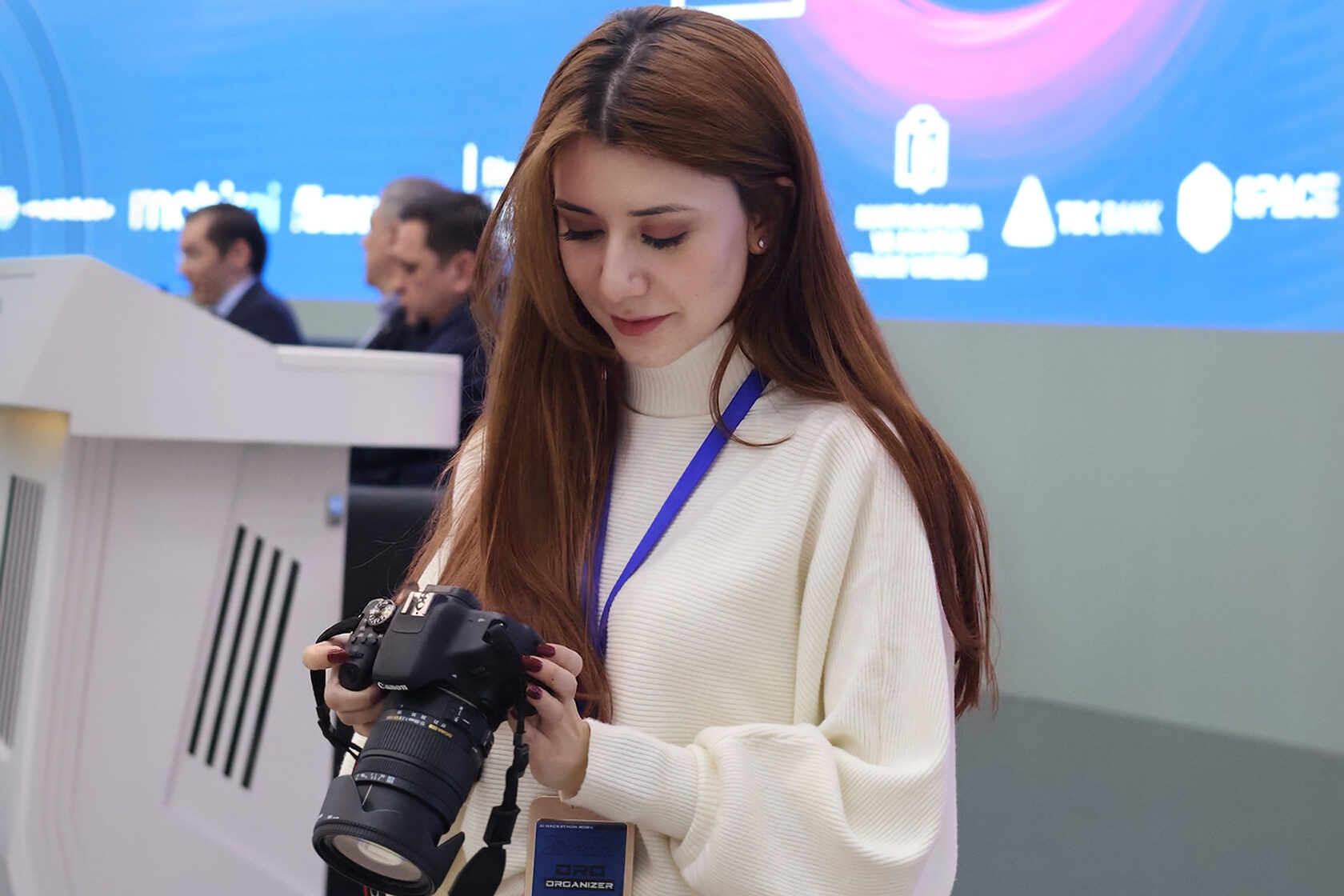
One of the most pivotal moments came during a hackathon where she met members of the ML Community of Uzbekistan — a community of developers, analysts, students, and researchers focused on advancing artificial intelligence technologies.
Kamilla ended up on the same team with them, and it was during this experience that she truly immersed herself in the field of machine learning. Later, she became part of the community, helped organize events, and supported initiatives aimed at engaging students in the study of machine learning.
Kamilla ended up on the same team with them, and it was during this experience that she truly immersed herself in the field of machine learning. Later, she became part of the community, helped organize events, and supported initiatives aimed at engaging students in the study of machine learning.

The transition from the university environment to real professional work was not easy. In practice, tasks are rarely defined as clearly as they are in academic assignments.
“In real work, you are not given a ready-made task — you are given more of a sense of a problem. The first step is figuring out where the real issue lies,” Kamilla explains.
She considers working with uncertainty to be one of the most challenging — and at the same time most fascinating — aspects of being a data scientist.
An important professional lesson came during a project where a model she had spent significant time developing did not deliver the expected results. That experience helped her understand an essential principle: before building complex algorithms, it is crucial to deeply understand the problem itself.
“In real work, you are not given a ready-made task — you are given more of a sense of a problem. The first step is figuring out where the real issue lies,” Kamilla explains.
She considers working with uncertainty to be one of the most challenging — and at the same time most fascinating — aspects of being a data scientist.
An important professional lesson came during a project where a model she had spent significant time developing did not deliver the expected results. That experience helped her understand an essential principle: before building complex algorithms, it is crucial to deeply understand the problem itself.

Today at Ucell, Kamilla works with large datasets, analyzes them, builds analytical models, and contributes to processes where data becomes part of real business decisions.
Interestingly, some of the people she first met during her studies at CAU and through hackathons later became her colleagues.
“Some of the people I met during university and hackathons are now my colleagues. Today we work together at Ucell, in the same team, on machine learning projects. For me, it’s a great experience — when people who once studied together are now solving real professional challenges together,” she says.
According to Kamilla, data science is far more than programming and mathematics. Analytical thinking, communication skills, and an understanding of business context are equally important in this profession.
Interestingly, some of the people she first met during her studies at CAU and through hackathons later became her colleagues.
“Some of the people I met during university and hackathons are now my colleagues. Today we work together at Ucell, in the same team, on machine learning projects. For me, it’s a great experience — when people who once studied together are now solving real professional challenges together,” she says.
According to Kamilla, data science is far more than programming and mathematics. Analytical thinking, communication skills, and an understanding of business context are equally important in this profession.

“A good data scientist is simultaneously an analyst, a researcher, and a translator between the world of data and the world of decisions,” Kamilla says.
Looking ahead, Kamilla plans to continue developing in the field of artificial intelligence and data analytics. In the long term, she would also like to share her experience through teaching or mentoring.
“One of the aspects I value most in my journey is the people — the professors and instructors at CAU who helped me see new opportunities. One day, I would like to do the same for others,” she says.
Looking ahead, Kamilla plans to continue developing in the field of artificial intelligence and data analytics. In the long term, she would also like to share her experience through teaching or mentoring.
“One of the aspects I value most in my journey is the people — the professors and instructors at CAU who helped me see new opportunities. One day, I would like to do the same for others,” she says.

Looking back, she notes that Central Asian University became more than just a place of study — it became the starting point of her professional journey, where an early interest in technology gradually transformed into a profession.